
Hillside perfect for cactus
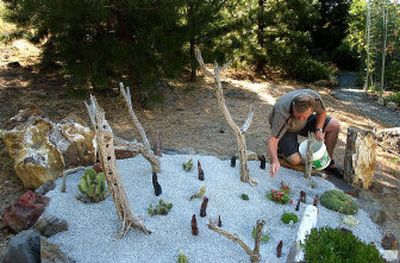

Allen and Alice Peterson face a major challenge in their garden on the west flank of the Dishman Hills in Spokane Valley. Their garden is carved out of the native rock with only a thin layer of soil over the rock. All of it is baked by the sun until late afternoon.
The Petersons knew keeping a conventional garden wasn’t practical in the harsh environment, so they began exploring other options. Cacti came to the forefront when Alice spotted a large native prickly pear in the garden of a friend nearby.
“They intrigued us. We like the blooms. They are very colorful. It was just something different that other people didn’t have,” said Allen.
There are actually a number of cacti that are hardy as far north as northern Montana, the Dakotas and into our own Columbia Basin.
Cacti need rocky or very sandy soil for quick drainage. The plant stores most of its moisture in its thick fleshy stems so it doesn’t need water as often as other plants. A good watering every three weeks or so, during summer, mimics the sudden downpours typical of the desert. The Petersons ran drip irrigation to their garden and turn it on every few weeks for a few hours.
Cacti need full sun, because their flat pads and stems have a limited amount of surface area to absorb sunlight. In their native environment, this protects them from scalding.
The spines on cacti are a defense mechanism that discourages animals from eating the plant, something that’s tempting for desert dwellers longing to get the moisture it holds. Nobody is going to chomp on something that gives back a mouthful of painful spines.
In the fall, hardy cacti pull moisture from their pads into the ground in preparation for winter. This keeps them from literally bursting when it freezes. The pads then collapse to the ground for winter, looking sort of dead in the process, but they come back in spring.
Cacti are easier to move and transplant than you think. All you need are very heavy leather gloves (welder’s gloves are perfect) or a pair of tongs to gently hold smaller plants. Their root system is not very large so it’s easy to gently work them loose and move them. Place them no deeper than they were originally, and firm the soil around them. Mulch with gravel, not bark.
A few of the Petersons’ plants are not winter hardy so they simply plant them in pots and sink them into the ground for the summer. Before the first frost, Allen Peterson pulls them out and brings them indoors to a bright spot for the winter.
Peterson also has been a rock collector for the past 40 years. He and his parents have traveled all over the West, bringing back pieces of petrified wood, volcanic basalt “bombs,” obsidian needles and more. His garden provides a great setting for the collection.
“I had the rocks, I had the dry land, I had the sun. Everything kind of came together,” he says.