
Folksy laughs for everyday folks
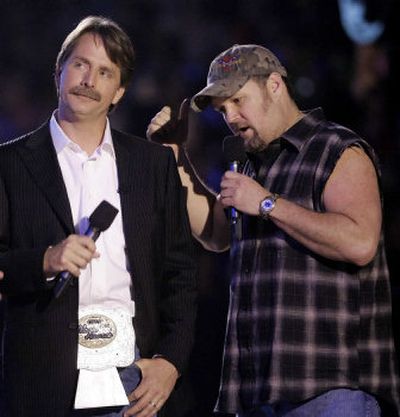
An awful lot of people think he’s the funniest thing this side of the Mason-Dixon Line.
But offstage, self-professed redneck Larry the Cable Guy is not really Southern and – on this recent afternoon at least – not really interested in being funny.
The Nebraska native, whose real name is Dan Whitney, is quiet, insightful – serious, even – as he ponders the success he and other comics are having on the album charts.
“I think people are way too into what comedians do,” says Whitney, who speaks with nary a whiff of the thick accent he puts on for his routine. “If people like you, you’re a nice person and you’re funny and you resonate well with them, they’re going to support what you do.”
Whitney, 43, a member of the popular Blue Collar comedy crew, should know.
His album “The Right to Bare Arms” debuted at No. 1 on the country albums chart in April 2005 and is approaching platinum status (1 million sales) – rare for a niche market where production costs are relatively low and 100,000 units sold is a success.
Four other comedy albums are among the top 75 on Billboard’s country chart: “Blue Collar Comedy Tour: One for the Road”; Roy D. Mercer’s “Black & Blue”; Ron White’s “You Can’t Fix Stupid”; and the late Jerry Clower’s “Classic Clower Power.”
On the pop side, comedy albums by Dane Cook, Lewis Black and the late Mitch Hedberg all have sold briskly, with Cook’s “Retaliation” going platinum.
Industry insiders say people look for laughs when times are tough. And while no one is claiming that war in the Middle East or rising oil prices are the sole reasons for comedy’s ascent, there’s some truth to the old adage about humor being the best medicine, says Wade Jessen, director of Billboard’s country charts.
The working class – country music’s traditional base – “certainly hasn’t shared in this economic prosperity that the Department of Labor would like everybody to think is happening,” Jessen says.
Country fans have long mixed music and comedy, albeit a cleaner, folksier style than the expletive-laced routines of Richard Pryor or Andrew Dice Clay.
From its earliest days, the Grand Ole Opry featured comedians such as Uncle Dave Macon, Grandpa Jones and Minnie Pearl.
Later, TV programs like “Hee-Haw,” “The Andy Griffith Show” and “Green Acres” expanded the reach of cornpone humor.
“More so than any genre of music, country has had a pronounced comedy component throughout most of its commercial history,” Jessen says.
Today, the hay bales and overalls are gone, but the blue-collar flavor remains. As Larry, for instance, Whitney delivers his one-liners in a sleeveless flannel work shirt and camouflage ball cap.
His humor can be raunchy, and his critics accuse him of being racist and homophobic. But the ultimate butt of his jokes seems to be the dimwitted hick he portrays.
“I know what my crowd will take. I don’t drop any F-bombs or use the Lord’s name in vain,” he says, conceding that despite those boundaries his act can, and often does, cross the lines of good taste.
“Would I do it for a church banquet? No. But can I do it at a fair? Yes,” he says.
“And I look at my crowds, too. If I see a lot of kids and older folks I will tone it down a lot.”
While proud to be a country comic, Whitney says his humor is broader than rural America. He’s as popular on classic rock stations as on country stations, and in the Northeast as in the South.
Along with the “Blue Collar TV” show on Comedy Central, he’s expanded into films with this year’s “Larry the Cable Guy: Health Inspector” and as the voice of Mater the tow truck in the hit movie “Cars.”
“I just consider what I do funny stuff,” he says. “Anybody can laugh at it.”