
All eyes on Katie
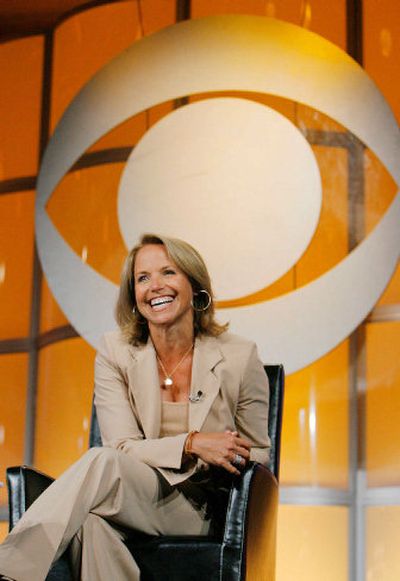
She is already the most heavily scrutinized, psychoanalyzed and gossiped-about news anchor in network history – and she hasn’t yet uttered a single “good evening.”
Katie Couric’s wardrobe has been analyzed by the Wall Street Journal, her makeup assailed in USA Today, her dating life examined by Parade magazine, her fitness for nightly news duty debated by columnists, cable combatants and bloggers.
“I’m really focused on work and trying to tune the other stuff out, because it could potentially drive you absolutely out of your mind,” Couric says in a conference room down the hall from the new set being constructed for her Sept. 5 debut.
When she takes the helm of the “CBS Evening News,” Couric’s challenge to NBC’s Brian Williams and ABC’s Charlie Gibson will mark the first such three-way showdown since Dan Rather, Tom Brokaw and Peter Jennings initially went at it in the early 1980s.
But the media landscape has shifted dramatically since then, leaving this trio fighting for a shrinking slice of the audience and increasingly taking their battle online.
After 15 years as a popular morning personality at NBC, Couric, the first woman to serve as a solo nightly news anchor, is armed with some new ideas – including a regular soapbox segment for advocates and activists – to jazz up an evening news format that sometimes seems set in concrete.
After conducting town meetings in a half-dozen cities last month, she concluded that “people are hungry” for more positive stories. She is, for example, working on a piece about a suburban Washington foundation that teaches juvenile delinquents how to build boats and helps them get high school equivalency degrees.
“Sometimes when you watch the evening news, it’s all gloom and doom – and some of it has to be, because the world is a complicated and pretty scary place right now,” says Couric, 49. “But there has to be a place for more hopeful stories.”
What viewers really want is a constant topic of discussion among the staffs of the evening newscasts, which still reach a combined 25 million people but have seen their share of the total audience gradually decline for nearly three decades.
Whether Couric can revive interest in the genre is the focus of considerable debate.
Williams, 47, who has occupied first place since succeeding Brokaw at “NBC Nightly News” 21 months ago, calls her a “great communicator” who “brings to the job an already established personal relationship with millions of viewers. She will be formidable competition, no ifs, ands or buts.”
Gibson, 63 – who took over second-place “World News” in June after Bob Woodruff was sidelined by injuries suffered in Iraq and ABC reassigned co-anchor Elizabeth Vargas – has said the showdown should be focused on news, not personalities.
“I believe competition is good for all of us,” says Jon Banner, “World News” executive producer. “It brings more attention to the evening news, which lots of people determined some time ago was going to go away.”
Public fascination with the anchors has reached the point that Gallup recently polled about them, as if they were presidential candidates.
Couric led the trio with a 60 percent approval rating – but, with 23 percent disapproving, had the highest negatives as well. Gibson got positive marks from 55 percent of those surveyed and thumbs down from 8 percent, while 47 percent approved of Williams and 7 percent disapproved.
CBS has helped to stoke interest in Couric as she takes the reins from Bob Schieffer, who will return to his Washington, D.C., job after 18 months as Rather’s interim replacement.
The network has launched a promotional campaign and tapped Academy Award-winning composer James Horner to write new theme music for the broadcast.
“It’s a good thing that everyone is talking about the ‘CBS Evening News’ right now,” says CBS News President Sean McManus. “The downside is that people are going to be so quick to jump to conclusions after one broadcast. Some things are going to work and others aren’t going to work.”
One of those elements is the new commentary segment, dubbed “Free Speech,” which will give a 90-second platform to outsiders – some prominent, some not – and include a weekly essay by Schieffer.
“People are sick of the lack of civil discourse,” Couric says, with guests “screaming and interrupting each other and trying to stay on message and berating the other person. They want us to get away from sound bites from inside the Beltway and roll up our sleeves and hear from real people.”
CBS executives are trying to downplay expectations of a dramatic boost for their last-place newscast.
“The ratings movement might be slow and very gradual,” McManus says. “Moving the needle takes a long time, I don’t care who your anchor is.”
Despite her years of experience interviewing presidents and world leaders on the “Today” show, Couric has faced skepticism rooted in her singing, dancing, cooking and other morning high jinks – even though press reports about Gibson rarely mention the lighter shtick he did during 19 years on “Good Morning America.”
“She’s America’s cutie pie,” says Robert Lichter of the Center for Media and Public Affairs. “She’s bringing star power to a job that has been a black hole in terms of losing viewers.
“She’s a devil to people who think TV news is losing its soul, and an angel to people who think TV news needs shaking up.”
Couric’s presence will be felt beyond the anchor desk. She is already working on two pieces for “60 Minutes,” one of which is related to Sept. 11, and will host a prime-time documentary about the fifth anniversary of the 2001 terrorist attacks.
She plans to appear daily on CBS Radio and blog at least once a week for the network’s Web site, fielding questions “if people have a beef with us. It just adds to the transparency we’re trying to promote. We just want to let viewers in a little bit on the process of how a newscast is put together and what decisions we make.”
In that regard, CBS is a step behind NBC, where Williams has been writing a daily blog since last year, and ABC, where Gibson anchors a 15-minute afternoon webcast that was downloaded nearly 8 million times in June.
With the average age of evening news watchers about 60, and the total number of viewers having dropped by half since 1980, network executives see the Internet as a new forum for reaching younger people accustomed to watching news and video online.
Couric says it would be nice if more young viewers knew “as much about the state of the country as they know about the state of Britney Spears’ marriage.”