
Former Paraguayan dictator dies at 93
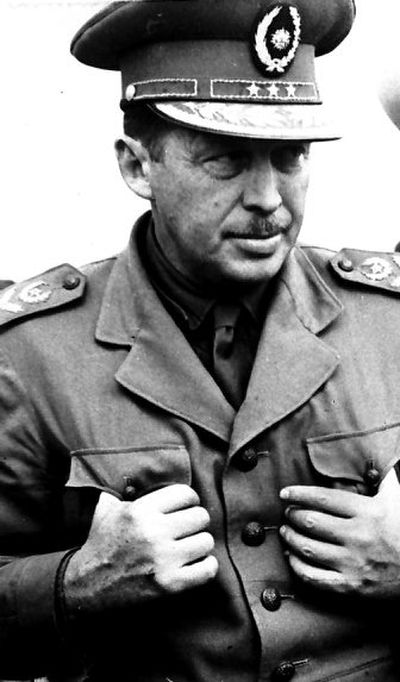
Alfredo Stroessner, the Paraguayan despot whose 35-year reign marked an uninterrupted period of repression in his country, which became a haven for Nazi war criminals, deposed dictators and smugglers, died Wednesday at Hospital Santa Luzia in Brasilia of complications from a hernia operation. He was 93.
Stroessner, one of the world’s longest-serving non-Communist heads of state, was forced from power in 1989 in a military coup. This led to his exile in Brazil, which did not act on Paraguayan courts’ later requests for his extradition on homicide charges.
Stroessner was a distinguished and ruthless army officer who in 1954 overthrew the president who appointed him commander of the armed forces. The coup itself was unremarkable in Paraguay, a landlocked, desperately impoverished country the size of California that had suffered through several wars and had seen nearly two dozen dictators come and go in as many years.
Seizing control, Stroessner brought early stability and foreign investment to the Paraguayan economy. With time, he shrugged off his less savory policies as “the cost of peace” and kept his country in a constant “state of siege” that overruled his democratic constitution.
He enforced a cult of personality that was unhealthy to challenge. Membership in his Colorado Party was a prerequisite for job promotion, free medical care and other services. Even opposition party members kept framed pictures of him in prominent rooms of their homes and offices.
“El Excelentisimo,” as he sometimes trumpeted himself, was elected every five years with near-universal approval that he took for a clear mandate. However, voting fraud was rife, and he tended to receive overwhelming support from dead constituents.
All the while, the economy became astoundingly corrupt. Payoffs were essential to all commerce, with much of the swag going to top military officers. Paraguay became a sanctuary for smugglers in arms, drugs and everyday goods like whiskey and car parts.
Stroessner, an anti-Communist, provided reliable Cold War support to the United States. He offered to contribute troops to the Vietnam War and the American invasion of the Dominican Republic in 1965. He also actively supported “Operation Condor,” the effort among other right-wing Latin American regimes to eliminate alleged leftist political threats. Operation Condor was aided by U.S. intelligence agencies.
At times, U.S. officials spoke out against Stroessner’s more blatant acts of violence against his people. But little was done openly to discourage him beyond a drop in financial support.
By the 1980s, former dictatorships such as Chile, Argentina and Brazil began to embrace democratic principles and shed military control. But an aging Stroessner was unable to change with the region. This accelerated his downfall amid the end of the Cold War, ruinous inflation and a visit by Pope John Paul II that encouraged dissenters and the church to speak out more boldly.