
Catholic television
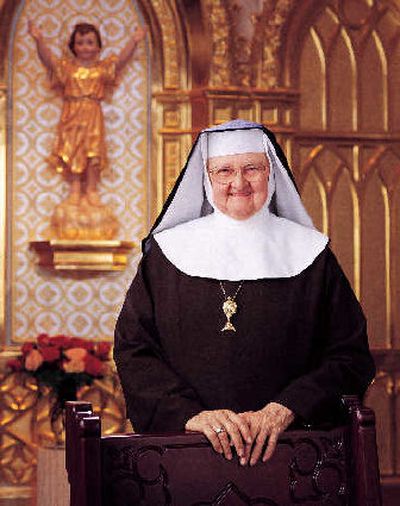

IRONDALE, Ala. – Twenty-five years ago, Mother Mary Angelica had a vision for Eternal Word Television Network, a channel offering nothing but Roman Catholic programming.
She had little more than faith, $200 and a garage to use as a studio.
Now EWTN Global Catholic Network, which debuted on Aug. 15, 1981, is available in 127 countries and more than 118 million households, from Illinois to India.
The satellite channel has grown to include radio and the Internet and bills itself as the largest religious media network in the world.
Still based at its original campus in a hilly Birmingham suburb, EWTN has long had the blessing of the Vatican.
And while critics alternately accuse the network of being too conservative or too liberal, it prides itself on sticking to the leadership of both Pope John Paul II and his successor, Pope Benedict XVI.
“People need to know what the Vatican is saying, what the pope is teaching,” says Sister Mary Catherine, a nun long associated with Mother Angelica and her religious order, the Poor Clare Sisters of Perpetual Adoration.
“They hear so much it is hard to know the church’s position. EWTN straightens that confusion out.”
Sister Mary Catherine is mother vicar of the multimillion-dollar monastery where Mother Angelica lives about 45 miles north of Birmingham in the town of Hanceville. Part of a cloistered order, Sister Mary Catherine talks with visitors from behind a black steel grate that separates her from the world.
Mother Angelica, having suffered a series of strokes, is no longer able to speak at length or tape her “Mother Angelica Live” shows for EWTN.
But she is still the most visible face on the network, which replays “classic” episodes of her shows weekly. Neither her name nor bespectacled image are ever far away at EWTN, where portraits and photos of the 83-year-old sister hang everywhere.
Thousands of visitors each year make pilgrimages to the media empire she founded, snapping picture after picture of control rooms, audio booths and the main studio.
“A lot of people see this as hallowed ground. It’s really kind of amazing,” says MaryAnn Plastino-Charles, creative director at EWTN.
Accompanied by four relatives, Earlene Reed drove nine hours from her home in Oakdale, La., for her second visit to the EWTN studios and a related shrine. It left her in awe.
“It’s God house,” she said. “Seeing the temple gives you the same feeling as seeing the Grand Canyon for the first time.”
Mass is televised daily worldwide from a small chapel at EWTN, which offers radio and TV programming in English and Spanish.
On Sundays, afternoon services are televised from the huge, gilded church in Hanceville. Robotic cameras are hidden in the chancel area and ceiling, so most visitors can’t tell that the ornate sanctuary doubles as a television studio at times.
Perhaps a sign of its influence, EWTN is under attack from both sides of the theological spectrum.
Liberal and moderate Catholics sometimes refer to the network and Mother Angelica as being mouthpieces for the church’s right wing, a worldwide force for promoting conservative Vatican policies against abortion, birth control and the ordination of women as priests.
Catholic traditionalists, meanwhile, accuse EWTN of bowing to contemporary society with a mix of rock music, modern thought and overly ecumenical teachings.
Attorney Christopher Ferrara earlier this year published a scathing book titled “EWTN: A Network Gone Wrong,” which portrays the channel as a threat to true Catholicism.
“EWTN is a veritable network of apostasy that is using the medium of television to give modernism a power over Catholics that it has never had before,” Ferrara, chief counsel for the American Catholic Lawyers Association, wrote in a column promoting his book.
The network, meanwhile, notes that it has its own theology department that screens everything going on the air to conform with Vatican teaching.
“If there’s a book we’re going to mention, we read it first,” says Colin B. Donovan, vice president for theology.
The nonprofit EWTN reported $31.4 million in revenues and $32.9 million in assets on tax forms for 2004, the last year for which records are available online.
An associated catalog division reported making $3.2 million on sales of $4.8 million that year, with the profit going back to the network.
EWTN never charted a formal plan for growth. Instead, says Sister Mary Catherine, Angelica and the other nuns prayed and trusted in God to provide.
Donors paid for expansions to the television and radio headquarters – which resembles nothing if not a multilevel maze – and five families gave an undisclosed amount to build the monastery and shrine, which was consecrated in 1999.
“We struggled at first. We didn’t have any money,” Sister Mary Catherine says. “Everything grew and grew, and expenses got greater and greater.
“As we trusted more and more, everything was taken care of.”