
After death, back to basics
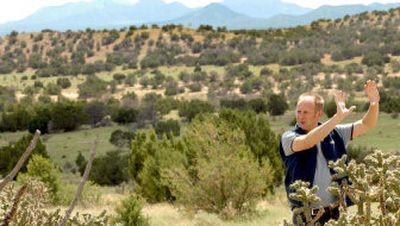
GALISTEO BASIN PRESERVE, N.M. – Tromping across a small grassy meadow ringed by pinon and juniper trees and dotted with cactus and clumps of bright yellow flowers, Joe Sehee suddenly comes to a stop.
“That’s definitely a burial area,” he says, peering at the gently sloped, south-facing hillside. “It’s somewhat protected, so you have a feeling of being comforted here.”
Soon, he says, visitors to this patch of ranchland will be able to admire the view – uninterrupted for miles – then scout out a spot to be buried, in graves marked by rocks or trees or newly sown wildflowers or nothing at all.
A proposed 10-acre “green burial” site is a small but singular component of an ambitious conservation and community development project under way about 15 miles southeast of Santa Fe. It’s part of a small but growing movement to offer environmentally conscious cemeteries and protect open land in the bargain.
Commonweal Conservancy is buying a 13,000-acre ranch, of which nearly 12,000 acres is slated for preservation as open space available for use by the public.
“The landscape is gorgeous, just spectacular classic West – buttes and grasslands and mountains,” said Ted Harrison, founder and president of the conservancy.
Development on a small slice of the ranch – principally 300 acres devoted to a mixed-use, mixed-income village of as many as 965 homes – is providing the money for the project, named the Galisteo Basin Preserve.
A “memorial landscape” that Sehee is planning about a mile from the village would be open to residents and nonresidents, for the earth-friendly burial of ashes or of unembalmed bodies in biodegradable boxes or in shrouds.
It, too, would fund conservation: Roughly half of what someone paid for the right to be buried here would be used to buy and preserve nearby acreage.
Harrison says combining conservation and “environmentally conscious” development makes sense, particularly as public money for land acquisition dwindles and ranchers in the West face increasing economic pressures to sell.
“I think it’s one of the ways that we can preserve the open space and habitat values of these historic ranches,” said Harrison, who spent 18 years with the Trust for Public Land, a national land conservation organization.
And while he acknowledges that in the world of romanticized real estate pitches “you don’t do death in a master planned community,” Harrison says having a burial site near the proposed village – with its homes, shops, schools and workplaces – will make for a more complete community.
“If that cemetery is there as a reminder of life’s fragility and preciousness, what a difference in the consciousness of this community,” Harrison said.
Michael Fischer, a former executive director of the National Sierra Club and the California Coastal Commission, says green burial is a new tool for conservation organizations, which in the past have been skeptical about being linked to the burial industry.
For a conservation group that wants to protect a piece of land “in perpetuity,” it has the plus of making that place special to generations of families of those buried there, he said.
And there’s a growing market for simple burials in an environmentally sustainable manner, said Fischer, who is an adviser to the Green Burial Council, which Sehee founded. The council recently came up with standards for the certification of green cemeteries.
“My own sense is that the demand is quite great,” Fischer said.
More common in the United Kingdom, green burial sites can be found in just a handful of states, including New York, California, Texas and Washington. The Ramsey Creek Preserve in South Carolina, which opened a decade ago, is the oldest.
Sehee, a former Jesuit lay minister, said consumers would be charged about $4,000 for a whole-body burial and $1,000 for the burial of ashes at the Galisteo Basin Preserve. About half of that would offset the costs of starting and operating the cemetery, while the rest would go toward land preservation.
Families that wanted to make large conservation purchases – of $1 million, for example – with attendant state and federal tax advantages would get private family burial sites of 500 acres, Sehee said. Ten such sites will be available.