
Follow in footsteps of Lewis and Clark
The Lewis and Clark celebration is just about finished. Although all the hoopla and formal commemoration is over, now may be the best time to explore the country that the famous explorers traveled. New roadside exhibits, interpretive centers, roads and signage are all still there and will be for years to come. There now is time and space to reflect on and enjoy this part of our national history.
The Corps of Discovery was canoeing down the Columbia River, staying close to the north bank (which is now in the state of Washington). Meriwether Lewis and William Clark finally arrived within the view of the Pacific Ocean after 4,100 miles of travel up the Missouri, over the Rockies and down the Columbia River.
Journal entry: Nov. 15, 1805
Clark – “Great joy in camp. In full view of the ocian. This great Pacific ocian which we been so long anxious to see.”
But the joy of the sound and sight of the ocean was quickly changed to dismay. The corps was pinned against the rocky, steep shoreline by the waves, by the strong wind and by the constant driving rain. Huge drift logs 4 feet in width and 200 feet in length kept crashing around their canoes and tiny campsite terrifying them. Their clothes were rotting off their bodies. They were trapped for six miserable days. Finally, at low tide, Lewis with three men made it further along the shore where they could set up a station camp away from the water. The others followed. At the end of their journey west some men did explore by land to the very end of the Columbia River. Although the journal entry does not express any emotion at this point in their journey, they must have felt relief and satisfaction.
Journal entry: Nov. 15, 1805
Clark – “I landed and formed a Camp in the highest spot I could find. This I could plainly see would be the extent … of our journey by water … in full view of the ocian … from Point Adams to Cape Disappointment.”
Lewis and Clark were exploring what is now Washington state land at the mouth of the Columbia River as it flows into the ocean. More specifically, they were in what is now called Cape Disappointment State Park, formerly called Fort Canby. This is a wonderful state park and a Lewis and Clark destination site. There are more than 1,200 acres with 250 campsites, each with a table and stove/fire pit. Sixty of the sites have water, sewer and electricity. A newly expanded and completed Lewis and Clark Interpretive Center is open. Originally built in 1976 to commemorate the success of the expedition, the center has almost completed a major renovation. It is high on a bluff and has a panoramic view of the Columbia flow into the Pacific.
McKenzie Hill is the closest and tallest rise near the ocean and the mouth of the river. Find the trailhead just off the main road in the state park that goes to the campground. The trail is a fairly steep, half-mile walk to the top. Take your time – the rise of elevation is worth the effort. There is a spectacular view of the ocean to the northwest with breaking waves along the shoreline, the enormous mouth of the Columbia River to the southeast and the city of Astoria, Ore., straight across the river. It’s easy to imagine Lewis and Clark’s feelings as they gazed at the same sight without the city of Astoria. They stood near where you are standing.
Journal entry: Nov. 18, 1805
Clark – “I set out with 10 men and my man York to the ocian by land … (later in the day) I found Capt Lewis name on a tree. I also engraved my name … I assended this hill which is covered with high coarse grass. Decended to the N. of it and camped.”
There was an interesting decision that Lewis and Clark made at this point of their journey. Ryan Karlson, a Washington State Parks interpretive specialist, explains that the weather was still very bad and they had to decide where they would spend the winter. They had three choices: stay where they were, go back up the river or cross the river into what is now Oregon. They decided that every one should vote on what to do. Stephen Ambrose states in his book, “Undaunted Courage,” “This was the first vote ever held in the Pacific Northwest. It was the first time in American history that a slave had voted, the first time a woman had voted.” That woman was also an Indian.
Scientific discoveries
Two hundred years ago the Columbia River was home to the California condor. Here is the first recorded description of this bird. Clark was so impressed he also sketched the bird’s head in his journal.
Journal entry: Nov. 18,1805
Clark: ” Rubin fields killed a buzzard of the large kind … measured from the tips of the wings across 9 1/2 feet.”
Nearby attractions
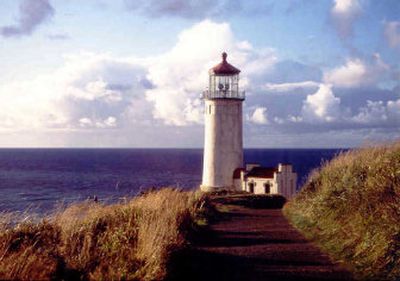
There are two lighthouses to explore at Cape Disappointment State Park. The Cape Disappointment light faces the Columbia River. It is the oldest working lighthouse on the Pacific Coast. Another tall, beautiful lighthouse, North Head, faces the ocean. There are not too many locations where two lighthouses can be visited at the same site.
The cape got its former name, Fort Canby, as a military location that was used to protect the entrance to the Columbia River. Cement gun batteries can still be explored on the bluffs facing the river. There is also an active Coast Guard station where sailors are taught how to rescue foundering ships in the treacherous waves and sandbars found at the mouth of the river.
The Long Beach peninsula offers resort towns where food and accommodations are available. A seafood menu is easy to find. They are all close by the state park and its attractions.
Web sites
“Fort Canby: www.capedisappointment.com
“Vacation houses: www.parks.wa.gov/vacationhouses
“Washington State Parks: www.parks.wa.gov
Phone contacts
“Cape Disappointment: (360) 642-3078
“Camping Reservations: (888) CAMPOUT
“WA Parks Information Center: (360) 902-8844