
Sandpoint teen tops in horse-judging show
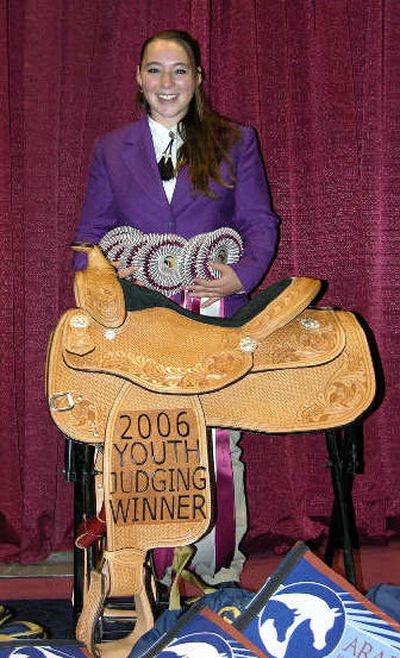
When 15-year-old Sandpoint resident Merisa Turnbaugh left for Louisville, Ky., recently to compete at the Arabian National Horse Show Youth Judging Contest, she hoped to come home with some ribbons and an increased knowledge of what it takes to be a good judge. The last thing she expected was to come home a national champion. But that’s exactly what happened.
“I was so shocked I won,” says Merisa. “It was a one-in-a-million chance.”
The competition is a prominent judging contest held annually in conjunction with the U.S. National Arabian and Half-Arabian Championship Horse Show. Participants can enter under one of three divisions – 4-H, the Arabian Horse Association or a Collegiate Judging Team – but compete against all entrants, meaning Turnbaugh was matched up against college-age contestants. This year, the fifth that Merisa has attended, she entered in the Arabian Horse Association division.
Participants judge a total of four halter and six performance classes. In a halter performance, Merisa explains, contestants look at qualities such as a horse’s structure as well as its suitability for breeding. In a performance class, participants look at things such as the attitude of a horse and how a rider appears on the horse. Their critiques are scored against an ideal ranking determined by a panel of three judges.
In addition to the judging portion of the contest, the participants must also give an oral presentation supporting their critiques. It encourages the participants to think, organize their thoughts and eloquently articulate reasons supporting their results using comparative terminology. Oral presentations are judged on organization, relevancy, accuracy, terminology and presentation.
“That is probably the hardest part of the whole competition,” Merisa says.
She and her mother, Angela, attribute much of her success to her leaders, Barbara and Laurie Tibbs, sisters who were Angela’s 4-H leaders when she was younger.
“You can be around Barbara and Laurie for a day and they can totally inspire you,” says Merisa.
During each meeting, which is at least once a week when preparing for the national competition, the women require the girls to make two oral presentations.
“I make up classes for them so they are all judging the same horse,” said Barbara Tibbs, a Sandpoint High School English teacher.
She said that although the speaking portion of the competition did not always come easily for the girls, she was impressed with how much better her own team was at oral presentations than those she saw at the college level.
“All these girls can create an excellent mental picture of the horses,” said Tibbs. “These girls are some of the most polished speakers in the country.”
Merisa, a poised, confident and polite teenager who has been home-schooled since kindergarten, has always had a love of horses.
She helps tend to the family’s seven horses as well as two cows and a sheep, but her love of horses really shines through.
“I’ve ridden since before I could walk,” she says.
Learning to become a good judge is very involved and takes hours of hard work and study.
Angela compares her daughter’s training with that of a bank teller. She said bank tellers can look at a bill and know exactly what imperfections to look for in determining whether the currency is counterfeit. Similarly, Merisa has the ability to look at a horse and know exactly what qualities it has or lacks.
“I can hardly look at a horse now and say that it is pretty without Merisa saying its shoulders are too steep or its back is too long,” said her mom .
As a result of her hard work and dedication, Merisa not only finished top in the nation, but she also won an engraved Western saddle, a $750 scholarship and a scholarship to a judging seminar. She and her teammates, who range in age from 11 to 18, also finished second overall as a team.
Barbara Tibbs was not surprised at the successes.
“With Merisa, I had a feeling this day (of being a national champion) would come soon,” she said.. “She is a perfectionist. She asks questions all the time and always wants to learn. She has a very analytical eye.”