
Raul Castro leads revolutionary parade
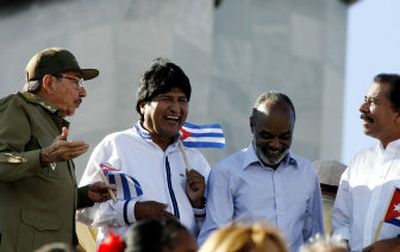
In a strong indication that Cuba’s Fidel Castro era has ended, an ailing Fidel failed to appear at a massive military parade in his honor Saturday while his brother and designated successor delivered an inaugural speech of sorts.
Without explaining his brothers’ absence, Raul Castro renewed his willingness to negotiate an end to the almost 50 years of animosity between Washington and Havana. But on his own terms.
“We want to reaffirm our disposition to resolve at the negotiating table the prolonged dispute between the United States and Cuba, if and when they accept our country’s condition that it will not tolerate any shadows over its independence,” he said.
Many Cuba-watchers had expected Fidel Castro to make his first public appearance at the parade since undergoing surgery in July and “temporarily” surrendering the presidency to his brother. At that time, Fidel asked that celebrations for his 80th birthday on Aug. 13 be postponed until Saturday.
But Fidel’s absence was certain to fuel U.S. reports that he suffers from terminal cancer and likely will not live past 2007. The Cuban government has refused to detail his ailment, only repeating incessantly that he is “recuperating.”
Cuba’s media said 300,000 soldiers, students and workers marched along the Plaza of the Revolution as Russian-built MiG jets soared overhead, tanks rolled, and the nation’s elite watched from the perch of bleachers.
Many of the marchers chanted, “We love you Fidel” and “Viva Raul,” and some carried signs praising the revolution, launched Dec. 2, 1956 when the yacht Granma landed in eastern Cuba carrying the Castro brothers and 80 other fighters.
But in other parts of Havana, the capital seemed largely quiet and almost lifeless on a Saturday morning, with only a dampened sense of the celebrations of the birthdays of Fidel or the revolution.
Some Havana residents interviewed by the Miami Herald on Saturday seemed to accept that Fidel is on his last legs yet – at least in public and before strangers – insisted that his ideology would survive his death.
“His death will not change anything. It will not mean they can come in and take over,” said 83-year-old Sergio, referring to Cuban exiles abroad.
Leading the military display was Raul Castro, still referred to by the Cuban media as defense minister rather than acting president. After a brief introduction by a teenager, Raul gave the only address of the parade.
It was the second time in Raul’s rare recent public statements that he mentioned a willingness to work with Washington. But his calls are likely to fall flat for the time being since Bush administration policy is to push for democracy in Cuba – and oppose the kind of succession from one Castro to another that Raul’s speech signaled.
“The absence of Fidel at this parade means that Dec. 2 marks the start of the post-Fidel era,” said National War College professor Frank Mora. “The eulogies have begun, history and legacy will inform everything, but the message is clear … a new era and model of governance has begun.”
Raul led the parade aboard a Soviet-era military vehicle, accompanied by three original commanders of the revolution: Ramiro Valdes, Juan Almeida and Guillermo Garcia.
“We are convinced that the way out of the distressing conflicts that humanity faces is not through war but through political solutions,” Raul said.
The Bush administration reacted to Raul’s speech by reiterating its previous position: The communist government must first initiate a democratic opening – an option long rejected by the Cubans as interference in their internal affairs.
Assistant Secretary of State for the Western Hemisphere Thomas Shannon in August specified some of the U.S. conditions: freeing political prisoners, respecting human rights, permitting the creation of independent organizations such as political parties and trade unions, and “creating a pathway” towards elections.
Since Fidel announced plans for Saturday’s event four months ago, he has appeared only in sporadic videos and photographs that showed him shrunken and weak, sometimes in pajamas or a loose-fitting tracksuit.
But those weren’t the images shown Saturday on Cuban television, which broadcast hours of historic clips of a younger, stronger, triumphant Castro.