
Playing well with others
If throwing hand grenades and destroying enemy base camps gets old, the developers at Cyan Worlds have prepared the ultimate alternative to rock ‘em, nuke ‘em video games. By the end of the month, the Mead-based game company will unleash its new version of Uru Live. The story behind the game is a layered history of an ancient people whose lost civilization has been excavated by a group called the D’ni Restoration Council. The council is restoring the ruins of the great D’ni cavern, but strange things start happening. The vast D’ni empire begins to be reborn; so does an unknown evil threat.
In a step that is probably the first of its kind, Cyan will have a team of online players – game masters – available during prime time so that new players can learn about Uru and explore the complex environment they’ve entered.
This won’t be a phone-bank crew of techies in some basement. Instead, Uru players will get help from people who have entered the same game world, who move around as characters and can talk directly with other players.
“Our focus will be to help new players understand the game and get oriented,” said Lloyd Bell, director of customer support and quality control for Uru Live.
For instance, in reply to a puzzled Uru player, a Cyan worker might respond, “Did you go over to the city and look around for clues?” Or the tech-support worker could say, “Do you know the story behind that event?”
Cyan’s vast network of diehard fans have always preferred helping one another solve puzzles and mysteries, “so we decided to follow that example,” Bell said. “Our guides are there to help find others in the game, who can work on solving a problem together.”
The company’s customer support group will never respond to a question with, “hold on a second while I look up the answer in my computer,” he added.
Three years ago, Cyan co-founder Rand Miller watched as workers finished the first version of Uru for a different publisher. In November 2003, the company released a boxed version of Uru (selling for $49) and prepared to launch an online version that would have allowed ongoing game development and regular expansion of the basic story line.
But the publisher at the time, Ubisoft, pulled the plug on Uru just before the game was set to go online.
This time around, Miller and his group of roughly 40 Cyan workers are hoping the online experience provided by Uru attracts a steady throng of players.
Providing the logistical support this time is Turner Entertainment Co., a major division within media monolith Time Warner Inc. Terms of the deal in which Cyan and Turner share revenue have not been released.
This time around also, there is no stand-alone boxed version of Uru, said Miller. “It’s only available online. That’s the only way to play,” he said.
Getting to play will cost gamers a monthly fee of $9.95. For the price of admission, many might even run (figuratively) into Rand Miller himself, who plays a character in the Uru saga.
“He really does play himself,” said Bell. “He’ll be there, right in the game, and people can interact with his avatar” – the representation of each player as seen by others in the Uru game.
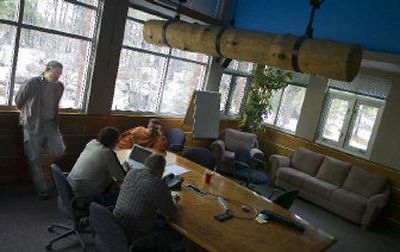
While Cyan has hired about 15 people to provide support, not all of them will be directly “inside” Uru. Others will be seated at work stations in the office, taking questions from players who submit chat or e-mailed questions involving hardware or software issues.
Miller believes the three-year span since the first Uru launch has helped by perfecting the technology that has to operate behind the scenes of the game. When players interact, move objects, scan the environment or respond to a threat, the game play has to be seamless, he said.
“The one thing you don’t want to happen is a player trying to move something or press a button, and nothing happens. That’s real bad,” said Miller.