
Bringing relief to Uganda

Friday morning, Angela-Marie Slotten was scheduled to climb aboard a KLM flight to Uganda, packing along DEET spray, Luna bars and 200 fine, stainless steel needles.
She planned to arrive in the capital city of Kampala late Saturday night to join the Pan African Acupuncture Project’s unique efforts to benefit people with AIDS. She’ll be part of a team of American acupuncturists who will train Ugandan nurses and midwives to insert those whisker-thin needles in simple treatments designed to alleviate symptoms such as diarrhea, weakness and pain.
“I’ve seen a lot of heartbreaking things around HIV-AIDS,” says Slotten, an acupuncturist with an office on Spokane’s North Side. “I’ve seen a lot of people die with complications from AIDS, but I haven’t seen it at this level.”
Slotten speaks in relaxed, soothing tones. She’s 41. She gazes intently through green eyes and wears her reddish brown hair pulled back from her face. She discovered this project in June, she says, when she was searching the Internet for continuing education classes.
“It just seemed like a perfect match,” she says. “There’s a special spot in my heart for HIV-AIDS, and there’s a special spot for Africa, too.”
Before Slotten trained as an acupuncturist at Seattle’s Bastyr University, she served as a social worker for 10 years, eight of them working with AIDS patients at places like the Pierce County AIDS Foundation in Tacoma.
Now Slotten works with Rosemarie Asterino, a veterinarian who uses acupuncture to treat animals. The sign outside their office reads “Acupuncture Center for People and Pets.”
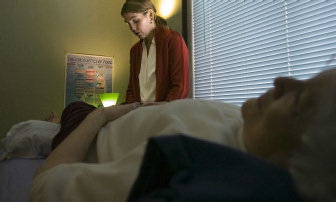
It’s located in a 1930s bungalow just off Northwest Boulevard. There Slotten’s golden retriever, Cedar, accompanies her to work each day. He often joins her clients in her treatment room, where a large poster of acupuncture points hangs on the wall, a coat rack made of carved Chinese snakes rests on the back of the door and a CD player pours a collection of cello suites into the room.
The combination of people and pets here often delights clients.
“Not only do I get treated for my headaches, I get a lesson in humility,” says Dr. Maria Yurasek, a hospitalist and internist at the Veterans Affairs Medical Center in Spokane. “It’s pretty cool to be sitting in a waiting room with a dog.”
Acupuncture, which has been examined by the National Center for Complementary and Alternative Medicine, shows promising results in a range of circumstances, from treating nausea and vomiting after chemotherapy and surgery to combating headache, low-back pain and myofacial pain.
While several studies have been done on acupuncture, relatively few of them measure up to the gold standard of the controlled, double-blind research prized by Western medicine, says Richard Mandell, the founder and director of the Pan African Acupuncture Project.
What Mandell does have, especially in Uganda, is plenty of anecdotal evidence.
He’s heard of patients coming into clinics on crutches but being able to walk out the doors after a single treatment. He heard of a Ugandan caregiver who practiced her new skills on a 12-year-old with chronic diarrhea. Conventional medicine hadn’t helped, but the symptoms stopped after one treatment and did not, to Mandell’s knowledge, return.
As for Slotten, she’s seen similar responses. She remembers an AIDS patient nearing the end of his life who was granted a last wish. With the help of acupuncture, she says, he was able to walk down a pier and go fishing one last time.
She also recalls a 3-year-old with AIDS who arrived with dull eyes and listlessness, yet was able to laugh and smile after his treatment. His mother and brothers called him “Little Buddha.”
That child later died of complications related to AIDS.
And that’s the thing about these treatments: They’re designed to alleviate the symptoms of the disease, not magically end it.
“We don’t at all pretend that we’re curing AIDS,” says Mandell. “We reduce pain and suffering, improve quality of life and instill a sense of hope.”
Slotten points out that AIDS tends to strike adults who support their families. Symptom relief may help ensure workers can keep buying groceries or paying for their children’s education.
Though acupuncture is believed to be more than 2,000 years old, its mechanism is still rather mysterious. Practitioners talk about life energy, called qi, (pronounced “chee”) which flows along meridians or channels throughout the body. The needles stimulate various points that can better release or balance blocked energy.
Slotten describes the treatment as working on the wiring of the house of the body.
“It’s getting those connections made, making sure those currents are flowing like they need to,” she says.
She frequently hears skepticism from clients. But when one of them says, “I don’t know if I believe in acupuncture,” she has a ready response: “Acupuncture is not a belief; it’s a medicine.”
The mechanism baffles most Western physicians, but that doesn’t stop them from referring patients for acupuncture or even seeking it out themselves.
Yurasek turned to Slotten for help with her migraines. She’d tried everything, including multiple medications and expensive experimental botox injections.
“Nothing was helping me,” Yurasek says. “I was suffering. I was losing so much of my life.”
Significant migraines, the kind that sent her to bed for the day, struck at least once or twice a week.
When she asked her neurologist, “What’s next?” He said, “Well, you could go on chronic methadone.”
The idea of taking the synthetic narcotic disturbed her.
“I’m not going to go on chronic methadone,” Yurasek said. “There has to be something else.”
She began visiting Slotten in July and begin to notice improvement after five treatments. Now she still gets mild headaches regularly, but the strong migraines come only once or twice a month.
“I think this has helped more than anything,” Yurasek says. “The intensity of the frequent ones has decreased, and the frequency of the big ones has decreased.”
Slotten hopes Ugandan patients will have similar results. The acupuncture project also trains caregivers to help people with tuberculosis and malaria.
She plans to spend two weeks training nurses and midwives. After Kampala, she’ll visit clinics in Ibanda, Uganda. She’s heard the caregivers are often exhausted. While she usually treats 35 to 40 patients in a week, she expects her team will treat at least twice that many in a day.
“I understand it’s very, very long days,” she says. “Those are the kinds of things I’m just going to handle when I get there.”
The project works by asking the American acupuncturists to pay their own way. Slotten’s trip will cost approximately $4,000, and some of her patients helped pay the costs. They also voiced some concern about her safety.
Slotten says she’ll be cautious but not fearful.
“Life is too short,” she says. “Things need to be done. If something happened to me, I’d be doing something that I love.”
Slotten expects to work with a group of four acupuncturists from around the United States, and Mandell, who is based in Boston.
They’ll rely on simple treatments, such as one called The Four Gates. It targets the four points in the webbing between each thumb and index finger and on the top of each foot between the first and second toes.
“They’re a powerful combination for pain and decreasing irritability and anxiety,” she says.
They’ll also use a point called Three Mile, located on the leg and designed to improve digestion and increase energy.
“The theory is that if you have this point needled, the person can walk another three miles because their energy has increased so much,” Slotten says.
So far the program has survived by relying on donations of disposable needles.
“There’s not a lot of overhead,” Slotten says. “You can have some needles and be out in the middle of the jungle and give a treatment.”
The acupuncture won’t replace the drugs used to treat this virus.
But for AIDS patients, who may have up to 40 bouts of diarrhea in a single day, Slotten says, it can have remarkable results.
She knows working with such seriously ill people will challenge her. She expects to find it hard to sleep some nights.
But she also anticipates encountering joy. And she believes this will be only the first of many visits to Uganda.
“I’m sure,” Slotten says, “it’s going to be life changing.”