
Silver Mountain’s snow shapers
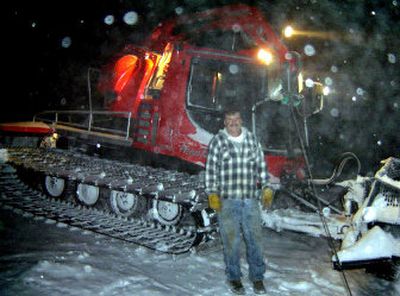

Their German manufacturer named the machines “Pisten Bullies,” and if that evokes an image of big, tough brutes, well, you’ve got the picture.
Take a ride on a Pisten Bully with Chris Burmeister, Silver Mountain’s chief snow groomer. He’s 48, a third-generation Kellogg native, a logger and heavy-equipment operator who’s been doing this snow-shaping business for eight years.
First, of course, you have to get there, and Silver’s “world’s longest single-stage gondola” doesn’t run at night. So, you make arrangements with Burmeister. He’ll pick you up in Kellogg at 10:30 p.m.
It’s a half-hour drive over the winding one-way road that, in the days of the Jackass Ski Area – predecessor to today’s Silver Mountain Resort – was the only way up and down the mountain.
Your destination is a garage that houses the big red machines. It’s near the resort’s Chair 4, a remnant of its Jackass days.
There you meet the other groomers on duty. The five men handle the one midsized and four giant snow groomers made by the Kassbohrer firm that fluff the ski resort’s slopes each night so skiers and snowboarder will have smooth schussing come morning.
Each groomer works the same runs night after night, so there’s no need for a lot of chatter. If something comes up that demands coordination or if there’s an emergency, the operators talk with each other through VHF radios.
Climb up onto a thigh-high track – one of the pair that propels this machine – then swing into the contoured passenger’s seat. Sit back as Burmeister fires up the 325-horsepower Mercedes-Benz diesel, turns on the heater and backs out of the garage.
The big brutes like Burmeister’s, with 19-foot articulated blades up front, are for the ski and board runs.
The midsized bully has a 10-foot blade that’s used to curry tubing runs and roads.
Burmeister explains that the vehicles’ tracks are the first “tools” used to form a good base. Then, the front blades tamp down the snow, adding 2 inches each night.
The groomer operators, he says, try to avoid scooping up dirt with the snow since the gravel would grate on skis and boards when the snowpack diminishes in the spring.
Within a few minutes, our machine encounters a depression in a road that connects the bottom of several runs to a chairlift. Burmeister uses the blade to scoop snow from the side of the trail and push it into the hole.
If he left the depression, he explains, skiers would have to pole hard and snowboarders would have to walk rather than slide to the lift.
As you churn along at the machine’s top speed of 7 mph, Burmeister explains that the tiller bar on the machine’s rear is what he uses to create and comb a loose top in the snow, the ideal being a 4-inch deep corduroy surface.
His machine is the only one of the five that’s equipped with a winch. That means it’s the one used to groom the steepest runs.
On this night, those will be Upper Steep and Deep, Rendezvous, Saddleback, Paymaster and Collateral, the slopes all approaching 45 degrees.
The cable, he explains, is 1,150 meters, and its candy cane-shaped housing swivels over the cab from rear to front.
Arriving at the top of Upper Steep and Deep, Burmeister hops out and drags the cable uphill. He hooks it into the loop of a short cable that’s affixed to a stout metal pole. That pole, he explains, is set deep into the hillside.
Returning to the cab, he turns the airplane-style yoke until the machine is pointed straight downhill, then starts the cable unreeling from the housing which is now at the rear of the machine.
A goose to the engine propels the groomer over the edge, then you’re staring down the slope, feet braced against the bar at the base of the windshield.
Down, down, down the run until you reach the bottom, then Burmeister turns the machine around. The cable housing revolves to the front of the groomer, then begins hauling the machine uphill, just overlapping the corduroy track formed on the downhill run.
And so it goes, four roundtrips, five, depending on the width of the run, then he unhooks the cable and you churn off to the next steep slope.
On the way, you pass two other machines heading for their next slopes. You can’t make out their shapes in the darkness; you know they’re there only because of the lights mounted atop their cabs.
The grooming goes on until 9 each morning. The last slopes of the 36 treated are the gentler ones used by beginners. That, Burmeister explains, is because those should be the softest and most forgiving while the slopes groomed earlier in the night may be slightly hardened by the cold.
For powderhounds, about 30 runs are left ungroomed.
By this time, the gondola is bringing up the first skiers and boarders of the day. It’s time to get aboard and head down to Kellogg and a cup of coffee, then to your car and home.