
Boat trip offers kids chance to see eagles

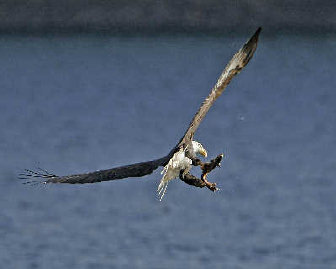
Among the many natural wonders that may draw one to North Idaho are the fish in our lakes. So, each year, from November to January, more than 100 Canadians come down to catch kokanee salmon in the Bureau of Land Management’s Lake Coeur d’Alene winter fishing tournament.
These Canadians are, of course, snow birds – bald eagles – which have just left their northern nesting grounds. And they are very welcome guests indeed. Rescued from a danger of extinction in the lower 48 states during my childhood, our national symbol is again available for all to see.
Not everyone who lives here cares that much – proximity breeds indifference – but one Friday morning, when it was way too early and way too cold, I joined a boatload of kids who were definitely excited at the prospect of seeing the Canadian visitors.
In what has become an annual event, schoolchildren of early elementary age are taken on boat trips to see the eagles at work. This particular boatload included students of Idaho Virtual Academy, an Internet-networked charter school program for many of Idaho’s home-schooled and smaller private-schooled youngsters (small schools, normal-size kids).
Every year at this time, BLM’s Scott Robinson gets pretty excited, too. He’s the federal biologist assigned to keep track of the goings on of these foreign eagles that have arrived to feast on spawning salmon. This particular morning it was his dubious honor to share his knowledge with these students – dubious, I say, because as with any field trip, excitement levels were high, and ample supplies of hot chocolate and cookies fueled hyperactivity.
Once eagles were spotted, most activity took place on deck. Inside where it was warm and dry, though, we first learned the basics of eagle biology from Robinson. We heard, of course, about problems eagles have suffered at the hands of man; 100,000 killed for bounty in Alaska, DDT-poisoned eggs, lost habitat. We also learned that eagles are pretty tough on each other. In lean fish years at their nesting lakes, with not enough food to go around, smaller eaglets get pushed out of the nest by voracious larger siblings.
That fact was noted by smaller brothers and sisters in the crowd, and there was a new level of respect shown bigger kids for the rest of that day. We were also told that eight out of 10 juvenile eagles die their first year due to starvation and predation – basically not being prepared to meet the rigors of life on the wing. For those who were paying attention, this put the issue of “do your homework” into a new perspective.
Furthermore, I learned that I’d rather be an osprey than an eagle. We were told the osprey that nest here and eat fresh fish during the summer migrate to South America long before eagles arrive. Eagles eat dead and dying salmon and then fly on to Utah for the rest of the winter. You ask any adult on that cruise, and they can instantly identify for you the brighter of the two species.
Upon reaching Higgens Point, we began to see eagles, so the lecture was over. We had spectacular, close-up views of both adult and juvenile eagles in small trees along the beaches and as they flew by on their way to Mineral Ridge. A whole host of pocket-size cameras flashed away producing pixel-sized black dots as representations of our national emblem.
I heard someone near the end of the trip say that about 70 eagles had been spotted. Most of the kids were lost long before that, though. I asked my 7-year-old daughter how many she had seen, and she thought about 10. At that age, there are only so many eagles one can appreciate, especially when they are half a lake away, in a tree, on a snow-splattered hillside. She was quite excited, however, and despite having had binoculars available, exclaimed, “I can actually see the eagles with my bare eyes.”
Kids being kids, the greatest excitement, I think, was generated by a close-up view of an eagle defecating. Yes, the wonders of nature.
Once parents and teachers became cold enough, kids were herded back inside for question time. Robinson was put on the spot by several especially clever students. “Do eagles eat whales?” “How do eagles keep their feet warm?” And one particularly intriguing question was, “Why do eagles eat fish?”
“Because God made them that way,” was the answer. Although as a former biologist I was left a little short, it worked just fine for Mr. Robinson. Some of the home-schooled kids probably get that answer a lot.
The eagles were beautiful and the kids were impressed, but they had no idea what a special privilege such a trip was. Had they been inclined to listen to a “back in my day” story, I could have told them that back in my day, seeing a bald eagle throughout most of the country was rare. Yes, back in my day, 10 bald eagles would have been quite a thrill indeed, just as it was this day for my daughter.