
Lessons of generosity
In countless homes this morning, it’s chaos. Children eagerly dive into mounds of presents, tearing off paper and ribbon with gleeful abandon. Exasperated parents wait, hope and pray to hear two simple words out of their children’s mouths: Thank you.
It’s an issue that many parents of young children struggle with, especially during the holiday season, when the gimme-gimme- gimme hype hits fever pitch: How can we encourage our kids to be grateful, generous, kind, charitable and empathetic?
The first step, several educators and parents agree, is to be a good role model. If you demonstrate these traits, there’s a good chance your children will, too.
“The bottom line is that we are our children’s best teachers,” said Chris Koehler, a WSU Extension Service educator who teaches courses in life skills, parenting and family living. “So the single-best thing we can do is model the kind of behavior that we would like to see in others and don’t necessarily expect kids to absorb it through osmosis,” Koehler said. “We need to talk about what we’re doing and why we are doing it.”
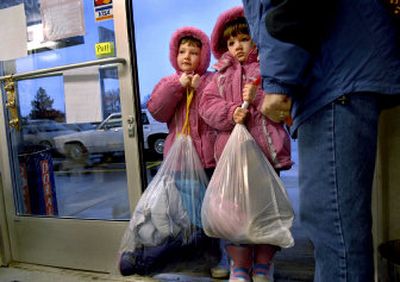
Carletta and Matt Brenneman of Post Falls encourage their daughters, Kaytlyn, 7, and Alexyn, 5, to be generous at home and in the community.
The family makes a point to help needy families during the holidays through their church, Trinity Lutheran in Coeur d’Alene. The girls have helped buy presents for children in need.
“We’ve always explained that Christmas is a season of giving, not getting,” Carletta Brenneman said. “My girls have never written a letter to Santa. Santa still comes, but it’s not about, ‘What I can get?’ It’s about, ‘What I can give.’ “
Carlyn Shaffer, a licensed in-home day-care provider and preschool teacher in Hayden, Idaho, takes a similar track with her two children, Grace, 8, and Travis, 10.
“I do this with my children. I take them with me when I go shopping for other people so they understand that Christmas isn’t just about gifts for them,” Shaffer said. “It’s about sharing love with the people you’re buying gifts for.”
She follows this up with a post-holiday tradition that’s becoming less common – the handwritten thank-you card.
“As time goes by and things change and e-mail and computers become more prevalent, the slower-paced ways of communication get forgotten or not developed,” Shaffer said. “I think it just helps them be appreciative of what they get and helps them appreciate the effort that other people made for their happiness. I think kids need to think about that, even if just for a moment.”
Never too young
Turns out basic manners may be a key to helping kids become generous people year-round.
Shaffer said children can begin learning to share and to have good manners when they’re able to verbally communicate. In her day care and preschool, kids are taught to say “please” and “thank you.” Instead of “I want,” she asks them to say “May I please have?”
“What I try to teach the kids here is respect,” she said.
For instance, children are not allowed to take toys from one another. But when it happens, Shaffer gives them the tools to settle the difference without a fight. The child who had the toy stolen is not permitted to steal it back. Instead, he’s instructed to ask “May I please have that back?”
“Nine out of 10 times, the child will give the toy back,” Shaffer said. “It blows your mind.”
Teaching manners and nice behavior will take some effort. Brenneman calls them the “Lessons of 50,” because, she said, it takes 50 repetitions before the message sticks. But they’ve caught on with her daughters, she said.
Her girls often ask to pray for friends at school who are sick. Each winter, the Brenneman girls gather up the previous years’ winter gear and donate it to Goodwill or St. Vincent de Paul. Instead of holding garage sales, the family passes on outgrown toys and clothing to friends and other families who can use them.
When the girls get cash gifts for Christmas or their birthdays, they tithe part of it to their church. Their parents give them something each week to put in the collection basket, but when it’s their own money, that’s something special.
“They just walk so proudly down that aisle to put their own money in,” Brenneman said.
Even when a child is in the throes of the narcissistic 2’s and 3’s, there’s room to begin teaching lessons. It won’t necessarily be easy. Ask a 2-year-old to help gather up old toys to give away, and she’ll likely have a meltdown. Instead, Shaffer suggested, ask the child to pick out one toy to give to someone who has none.
“When you’re talking about 2- and 3-year-olds, all you’re doing is planting seeds,” Shaffer said. “Don’t expect a child to act like an adult, because they can’t. All you can do is plant the seeds and hope when they grow they’ll grow into generous, giving adults.”
Helpful teens
Those seeds took root in Luke StormoGipson of Coeur d’Alene. For 17 years, StormoGipson sat at his family’s Coeur d’Alene dinner table, listening to and joining in discussions about the issues of the day. His physician parents – his dad, Justin, is an ophthalmologist; his mom, Maj, is a pediatrician – have included Luke and his two older sisters in their medical missionary work in Central America.
Now, the Coeur d’Alene Charter Academy junior is doing his part to continue the family philosophy of social justice.
He volunteers as a teacher’s aide at Ramsey Elementary School in Coeur d’Alene. Once a month, he and his fellow members of the Unitarian-Universalist youth group cook dinner for kids at the Project Safe Place shelter. This past summer, he put his Spanish skills to use, translating for patients at a medical mission clinic in Guatemala.
“I really enjoyed going on this trip because it’s such a great experience,” he said. “The people really appreciate the work you’re doing down there.”
His reasons for giving his time and energy? “I like doing it,” he said. “I think it does make you feel good, doing something that people appreciate.”
Carole Allen, a teacher at M.E.A.D. Alternative, the North Spokane alternative high school, says it’s never too late to start teaching teens about generosity.
Community service is a large part of the school’s program, she said. Because some of her students have been through the justice system, they view service as punishment. Changing that view is a first step.
“We really call it ‘service learning,’ ” she said. “We want them to learn from their service. We let them choose. Which projects interest you? Which are you passionate about? They’re usually fighting to go.”
The projects include everything from helping build houses through Habitat for Humanity to writing letters in support of aid for the war-torn African region of Darfur.
A simple project included a sock drive for homeless veterans.
“How do you get kids who have no money to go to the dollar store to get a dollar pair of socks? I guess the way we do this is we model it,” Allen said. “We bring in socks, then you begin telling the stories of the people in the street.”
The goal was to collect 40 pairs of socks. Fifty students instead collected more than 300 pairs. Then they visited the veterans center run by the Spokane Neighborhood Action Program and handed them out to the center clients.
“They love seeing the people they can help,” Allen said.
The M.E.A.D. students often are asked: How does it feel?
“How did it feel to see their faces and do something for somebody?” Allen said. “No matter how small the project, we keep asking that question and providing opportunities, whether it’s construction opportunities or baking cookies.
“Two weeks ago, we went to the Christ Kitchen,” she added. “Some of the kids just shoveled the driveway. The rest sat with the homeless women and just talked. And they learned.”
It’s all about providing experiences.
“They had an experience,” Allen said. “When you have an experience, you’re never the same.”
A year-round job
The work of raising children who are grateful, generous, kind, charitable and empathetic can’t be contained in the month between Thanksgiving and Christmas, Koehler said.
“You try to make it a 365-days-a-year practice where all you do is look around and see who needs a hand,” Koehler said. “Are your kids willing to shovel a sidewalk? Are they willing to mow a lawn? Or are they willing, when they see a neighbor lifting something heavy, to offer to help?”