
No holiday for veterinarians
Some staples of Christmas – ribbons on presents, treats in stockings and glowing candles – can spell disaster for the season’s furriest revelers.
On Christmas Day at the North Idaho Pet Emergency clinic in Post Falls, dogs were treated for eating too much chocolate, cats with half-eaten ribbons were examined and one cat was covered in candle wax.
It was just another day for Dr. Dean Aldrich, who joined a staff of three others to treat everything from a German shepherd mix with three broken legs after being hit on Interstate 90 to a Yorkshire terrier that swallowed a rock too big to pass through.
The shepherd’s legs were patched up for surgery preparation and the terrier’s rock was removed, all while most people sat with their families enjoying Christmas dinner.
Holidays are often some of the busiest days for pet emergency clinics, Aldrich said. Because other vets are closed, his place sees extra business.
“Everyone that’s here knows that working is part of the deal,” Aldrich said. “Everyone expects to be working, even on holidays.”
With each holiday comes a different set of typical complications. Around the Fourth of July, dogs frightened by fireworks run loose and are hit by vehicles. At Thanksgiving, some dogs get the circular bone of a round roast stuck on their snouts.
Around Christmas and New Year’s Day, consumption of candy tends to bring the little ones into the clinic. On Monday, area dogs seemed to have a sweet tooth for rocks. In addition to the tiny Yorkshire terrier, another animal ate a stomach-full of driveway gravel.
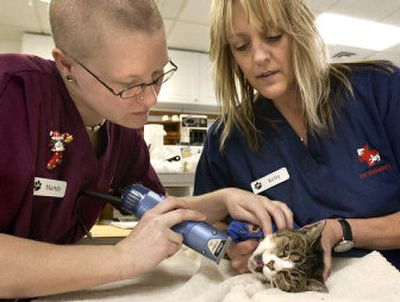
One 15-year-old tabby named Tiger entered the clinic late Monday, growling about a swollen lower jaw. Aldrich first used a syringe to drain the swelling, then he used a scalpel to lance the abscess.
Tiger was loaded up with painkillers and antibiotics and sent home with his owner.
But Niko, a 12-month-old German shepherd suffering from unknown ailment, wasn’t doing so well. He was losing weight rapidly Monday evening, and even though he was hooked up to an IV and getting fluids, his prognosis did not look good.
At least one dog or cat is put to sleep at the clinic each day, and Christmas was no exception. After fighting cancer and making it through one last holiday with its owner, a dying dog had to be put down Monday.
Staff members pulled a sympathy card from a stack, signed it, and gave it to the owner, a difficult task any day, but even more so on Christmas.
“We get pretty attached to some of them,” veterinary technician Kelly Lagrou said of the pets. But when a dog gets a Caesarean section and a litter of puppies is born, “it makes up for all of that,” she said.
Though the calls were expected to continue into the night, Aldrich passed his shift on to another doctor. After patching up dogs and cats for the better part of a day, he headed home to spend Christmas night with his wife and three kids.