
Wounded trees can wait until spring
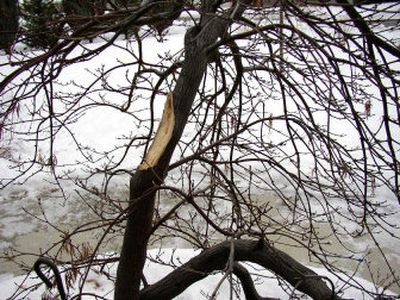

I live in the Wenatchee Valley and had a question hopefully you can help me with. I have an 8-year-old red laceleaf Japanese maple that was damaged in the recent windstorm we had. One of the large main branches broke off and left about a three-inch exposed area in the main trunk. It is quite a large chunk out of the trunk. What should I do to protect this area so it doesn’t further damage the tree? Do you think the tree will be OK? Please let me know.
Mrs. Sutherland, Wenatchee Valley
First, don’t panic. Unless a downed shrub or tree is in a position to still cause serious damage to life and property, time is on your side. Everything is dormant now, so the plants aren’t going to react to the damage until spring.
Where the wind tore branches off the trees, carefully trim the wound area so that it is close to the trunk. Do not use wound paints like Tree Heal or fill the damaged area with concrete or a sealer. “Trees don’t heal wounds; they basically wall them off,” says Ben Kapan, a certified arborist with Northwest Plant Healthcare. Research has proven that once the wound occurs, the tree naturally begins to protect the live wood from the wound. “The tree is equipped with the necessary processes itself to do that.”
Shrubs that got smashed should have broken branches removed, leaving the undamaged parts alone for now. In the spring, after the plant leafs out, remove any latent damage and shape the shrub. It may look funny for a while, but most shrubs will fill back in.
If you have broken trees that are going to need professional attention, get the best help you can. Remember that time is on your side and resist the urge to be a neat freak. It can wait until the tree service professionals have time to do a proper job.
Picking a good tree service can be a challenge. The Washington Department of Natural Resources has the following suggestions to help you pick the right one.
“Hire a company that is licensed by the state of Washington or Idaho, bonded, insured and employs International Society of Arborculture certified arborists. Although Washington requires tree service companies to register with the state, they are not required to adhere to proper pruning standards or even demonstrate any pruning knowledge to get a license. Make sure there will be a certified arborist with the crew that does your work.
“Beware of door knockers. Their low prices could prove costly. Most reputable companies will have business cards, neat truck signs and even uniforms that represent a professional level of service.
“Ask for references and check them out. Remember, you have time on your side here.
“Do not hire anyone who suggests topping trees. While this seems like the perfect simple solution, removing the leader causes trees to send up wild growth that eventually weakens the tree further and shortens its lifespan.