
Atlanta, nation mourn Coretta Scott King
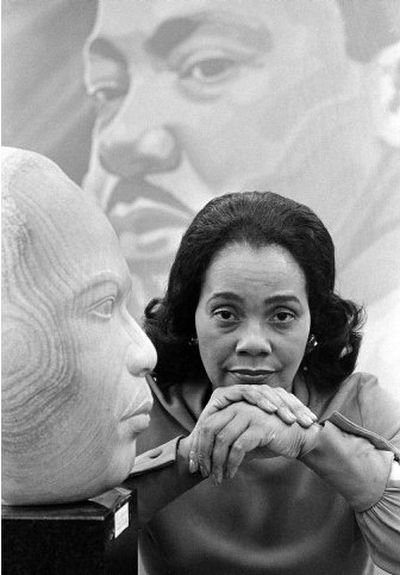
ATLANTA – A somberness fell over this city Tuesday, as Americans awoke to the news that Coretta Scott King, a tireless crusader for civil rights who devoted much of her life to preserving the legacy of her slain husband, the Rev. Martin Luther King Jr., had died in her sleep.
Flags throughout the state as well as those at the Capitol in Washington were lowered to half-staff. Mourners flocked to the King Center for Nonviolent Social Change, the institution she built in Atlanta, to lay roses near his tomb as a tribute to her unwavering devotion to her martyred husband.
King, 78, never fully recovered from a stroke and heart attack suffered last summer. Family members said she passed away in her sleep overnight at Hospital Santa Monica, a holistic health center in Baja California, Mexico, 16 miles south of San Diego.
“She lived a graceful and beautiful life and in spite of all the difficulties, she managed a graceful and beautiful passing,” said former U.N. Ambassador Andrew Young, a longtime family friend.
Following her husband’s assassination in 1968, King found her own mission in the struggle to bring national recognition to her husband. For more than a decade, she lobbied to make Martin Luther King’s birthday a federal holiday, and in 1983 President Ronald Reagan signed the bill into law.
She founded the King Center, a teaching facility, archives and museum, as a tribute to her husband’s work. Recently, the future of the financially-strapped center has been in jeopardy as her four children fought publicly over whether it should be sold to the National Park Service or remain in the family’s hands.
Born April 27, 1927, she grew up in rural Marion, Ala., walking five miles to school and picking cotton on weekends. The daughter of a lumber worker and a store owner, she rose to become one of the world’s most influential women. Though she relished her title as the wife of Martin Luther King Jr., she carved her own niche as an advocate for social justice, speaking out against the war in Iraq and in support of social issues such as gay and lesbian rights, AIDS advocacy and religious freedom.
After graduating from Antioch College in Ohio in 1951 with a degree in music, she enrolled in the graduate program at Boston’s New England Conservatory of Music. It was there she met her future husband, a budding young preacher who was a doctoral student at Boston University. They were married on June 18, 1953. A polished concert singer, she gave up a career in music to work alongside King. Occasionally she performed concerts to raise money for the movement.
Though she lived in her husband’s shadow for 15 years, King also had an invigorating influence on the civil rights movement for more than half a century. When her husband could not attend an event, she stood in for him and spoke on his behalf. She was often seen marching beside him in the front row, locked arm-in-arm, singing “We Shall Overcome.”
The Rev. Jesse Jackson, who in 1968 broke the news of King’s death to his wife, described her as a “freedom fighter” who provided stability for King.
“She walked with her husband during the ordeal of the Montgomery Bus Boycott. Their home was bombed, she endured the hate and violent anger toward their family. And she had to endure the constant knowledge that each time he left their home, he might never return,” said Jackson.
“She was the part of him that made him complete. She provided the home for him to go to when he left the battlefield.”
King is survived by her four children, Yolanda, Martin III, Dexter and Bernice. The family issued a statement saying the body would be returned to Atlanta and funeral services were pending.