
VA doctors declare emergency

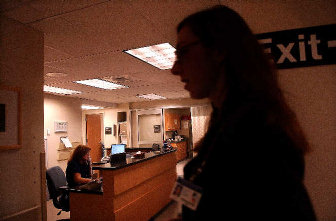
A group of doctors at the Spokane Veterans Affairs Medical Center thinks that the safety of emergency room patients at the facility is threatened by increasing workload, chronic staffing problems and lack of training.
In a letter to the medical center’s management, 10 staff physicians complained that a “decreasing pool of qualified physicians” must care for an increasing number of veterans on waiting lists for care. In many cases, these veterans “use the emergency room as a source of routine health care.”
The letter, delivered in June, was addressed to Joe Manley, the hospital’s director; Alan Prentiss, chief of staff; and Jacy Ryan, chief of medicine. The Spokesman-Review acquired a copy recently.
“Physicians here believe this ER is not safe, that someone is going to die because it is inadequately staffed,” said a physician who signed the letter but requested anonymity for fear of retribution by the medical center’s management.
Manley declined to be interviewed, but associate director Jane Schilke said steps have been taken to answer the physicians’ concerns. Since January, she said, a nurse practitioner has been assigned to the emergency room, which is typically staffed by one physician. The medical center also is seeking to hire another physician to help when the emergency room is busiest.
“We’re very concerned about providing appropriate care for our patients,” Schilke said.
All physicians on the emergency room rotation are adequately trained to allocate treatment, Schilke said. If a patient needs care that cannot be provided by the VA, the physician can see to it that the patient is transported to a local hospital.
The $3.2 million emergency room and urgent care expansion of the medical center was dedicated at a Veterans Day ceremony attended by U.S. Rep. Cathy McMorris in November. But the staff physician said that while Congress is good at providing funding for capital expenditures, it is not so good at maintaining VA operating funds at a level sufficient to sustain adequate staffing at hospitals.
“If it is an emergency room, it ought to be staffed as an emergency room,” said the physician.
Though Schilke said it was not the policy of management to fire staff for speaking to the media, no doctor interviewed by the newspaper was willing to be identified.
More patients than ever
Between 1995 and 2005, the number of patients treated at the Spokane medical center more than doubled to 21,000. Its budget has grown from $64 million to $80 million in the past five years.
About 1,500 are veterans on a waiting list of at least a month to be seen by a primary care physician, Schilke said.
A full-time staff physician typically sees 12 to 14 patients a day and has a caseload of 850 patients.
“We discourage longer waits, Schilke said. “They might have to wait 60 days for some types of appointments. Part of it has to do with soldiers returning from Iraq. Part of it is based on budget.”
The medical center has enrolled 542 veterans of the Iraq war, most of them in the past year, and 480 of them are receiving VA care.
Last summer, the Department of Veterans Affairs found itself more than $1 billion short in its budget, largely because of an underestimate of the number of Iraq and Afghanistan veterans seeking care.
Besides seeing more patients than ever, many of the Spokane medical center’s doctors are required to rotate through the officer-of-the-day duty roster. The officer of the day is expected to help out in the emergency room when needed, usually after his shift and between 4 and 6 p.m.
“I saw one guy at 7:30 (p.m.) who had checked in at 1:30,” said one doctor, whose workday began around 8:30 a.m. “He had driven from Okanogan with his family.”
The five-bed emergency room is usually staffed by a doctor under contract with a private firm.
Occasionally, because of scheduling problems with the contractor, the officer of the day has to independently staff the emergency room even after having worked a full shift in one of the medical center’s three clinics.
In their letter, the doctors said this may result in a workday lasting 24 hours or more.
“Often they have to stay and if they do, it’s usually for a couple of hours,” Schilke said. “There are exceptions.”
The officer of the day checks in after his shift to see whether there is a backlog of patients and helps out until the emergency room catches up.
The emergency room typically sees 15 to 20 patients a day, Schilke said. On weekends, there could be as many as 30 patients a day. “We do have bad days.”
She said the additional nurse practitioner and the staff doctor who hasn’t yet been hired “will provide coverage during the busiest part of the day.”
Last fall, Congress approved the physician pay bill, which seeks to help the VA become more competitive in hiring doctors. However, no funding was attached to the bill. VA hospitals have to increase the salaries of physicians, particularly specialists, out of their operating budgets.
Schilke explained that this was possible if the hospital reduces its costs by hiring fewer doctors on expensive contracts. Such contracts previously have been encouraged by the VA, under former Secretary Anthony Principi.
Concerns about training
The Spokane VA doctors also said that management has failed to clearly define “core competencies” required for providing safe patient care in the emergency room. These may include “suturing, reading X-rays, handling orthopedic or ophthalmic injuries, intubating or resuscitating unstable cardiopulmonary compromised patients,” according to the letter.
The medical center’s pharmacy and radiology department are closed at night, but radiology technicians are on call.
The doctors clearly expressed concerns about their lack of emergency room training in the letter to Manley.
“We request that management provide a statement, signed by the facility director, to each staff physician who will be required by management to practice independently in the emergency room, stating that the staff physicians may lack competencies to provide care in the emergency room but are required to do so as a condition of employment,” the letter said.
Schilke said the physicians asked to staff the emergency room have received training to do so, though it may have been some time ago. One doctor said he had not sutured in nearly 20 years.
“It’s not that they don’t have that training,” Schilke said. “They’ve all had it, but they get a little rusty.”
In interviews, VA physicians said that management has not adequately addressed their concerns since the letter was delivered in June. Schilke said their issues have not been ignored.
“They are legitimately concerned about providing the best care to patients and concerned about being asked at the last minute to work these shifts,” she said, later changing “legitimately concerned” to “sincerely concerned.”
She insisted that the doctors’ concerns were not a result of budget problems, but one of “matching staff with needs.”
One VA physician assessed the issue differently.
“In this time that we are sending our soldiers off to war, we are cutting off funding to take care of them when they get back,” the doctor said.