
Outstanding defense
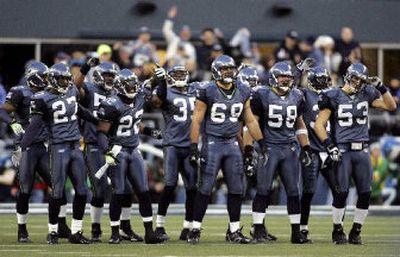
DETROIT – At Seattle Seahawks training camp in Cheney all the talk was about an improving defense, the promise of playoffs and possibly a Super Bowl.
It didn’t happen. In 2004, that is.
If you turn back the calendar, that was the year the defense was supposed to supplement a proven offense to make a complete football team. Instead, the Seahawks floundered, giving up 373 points and finishing 26th in total defense in the NFL.
So the Seahawks changed defenses. Not schemes, personnel. Depending on how one tweaks the math, Seattle has eight new starters – nine counting safety Michael Boulware, who started just four games a year ago.
Six new starters reside in the front seven. Rookie linebackers Lofa Tatupu and Leroy Hill (whoreplaced inured Jamie Sharper at midseason) moved in alongside D.D. Lewis, who was injured in 2004 and had just five starts in 2003. Cincinnati Bengals castoff Marquand Manuel has capably replaced injured safety Ken Hamlin. Four players have taken turns at left corner, where Andre Dyson starts when he’s healthy.
That doesn’t sound like the makings of an imposing unit, but it’s quickly becoming one. Seattle finished the regular season tied for 16th in total defense, but seventh in the more important category of points allowed. For standings purposes, they keep track of points, not yards.
“We have a whole lot of new faces but we jelled quickly,” said cornerback Marcus Trufant, a Washington State University product. “Everybody is headed in the same direction.”
Trufant is a prime example of the extensive makeover. He has 47 regular-season starts in his three seasons. No other defender who will line up Sunday against Pittsburgh has more than 25 (Grant Wistrom) in a Seattle uniform.
The defense has been stingier in the postseason. Washington mustered just 10 points, even with three Seattle turnovers, and 289 total yards. Carolina was held to 212 yards and its only offensive touchdown came with 5:09 left and Seattle in front 34-7. Those two opponents combined for 95 rushing yards.
“A lot of the guys committed themselves in off-season workouts,” Lewis said. “That’s where you start seeing the commitment to the team and wanting to get this done. When you have guys like that it’s really easy to get that chemistry going.”
Seattle was 26th in total defense after Week 12, but made a steady rise to 16th. The most impressive gain has been rush defense, where Seattle has jumped from 16th at midseason to fifth. Only Tiki Barber has rushed for more than 100 yards against the Seahawks this season.
“We didn’t adjust the defense, but we didn’t give them the whole enchilada at one time,” said linebackers coach John Marshall, who has filled in at defensive coordinator after Ray Rhodes suffered a stroke in September. “Not only were some of them young and inexperienced, but some of them were rookies and we had to bring them along. We put in our base stuff and as they were able to master that we gave them more and more.”
Tatupu and Hill have become cornerstones instead of concerns. Tatupu, a second-round draft pick from USC, has a team-high 105 tackles, four sacks and three interceptions. Hill, a third-rounder from Clemson, had 67 tackles, 7.5 sacks and two forced fumbles.
“You come in with the mind frame that you’ve got to be the guy,” Tatupu said. “That goes for everybody in this room. Nobody came in and said, ‘Oh, I just want to hang out for a couple years and then I’ll pick it up and have a stellar career.’ “
The two have avoided the mental wall that hits some rookies late in their first season.
“You are concerned about that at this level,” Wistrom said. “I hit it when I was a rookie just from a mental standpoint, but they haven’t seemed to have the falloff. They’ve done a great job.”
The secondary, torched by long passes in previous seasons, has kept big-gainers to a minimum. Seattle has one of the top red-zone units and the team is plus-10 in turnover ratio.
“We’re playing more disciplined, more sound,” defensive backs coach Teryl Austin said. “One big difference this year is the guys are doing a much better job of studying opponents so they don’t get caught by surprise as much.”
Surprise is a pleasantly appropriate word for this defense.
“It’s been surprising to see how quickly we came together,” said second-year tackle Marcus Tubbs, who had 40 tackles and 5.5 sacks this season compared to 13 and 1, respectively, in 2004. “A lot of defenses take years to really come together.”