
Catholics look to airwaves
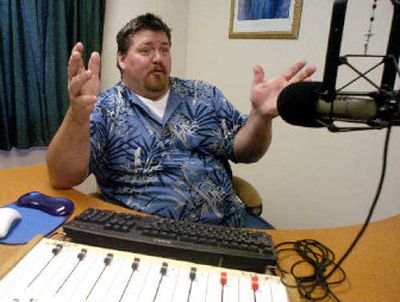
The Roman Catholic Church is the largest denomination in America, but you wouldn’t know it from religious radio.
The format is huge. Behind news talk and country, it was the third most numerous format among U.S. radio stations last year, according to the radio research firm Arbitron.
Yet the number of Catholic stations is only about 120, according to the Catholic Radio Association, out of about 2,000 religious stations nationwide.
Some broadcasters hope that’s about to change.
“We want to have somebody listen safely and anonymously. The only way to do that is to help stations get off the ground,” said John Lillis, a longtime broadcaster from Omaha, Neb., who consults with people who want to start their own Catholic stations.
The Catholic Radio Association has several dozen members and is hoping to add as many as 200 more if a so-called “window of opportunity” from the Federal Communications Commission opens in the next year.
That window will be the only time that nonprofit groups – including churches, universities and public safety groups – can apply for low-power FM stations. The association is appealing to the faithful to raise $150,000 in the next two months so as many as 200 new stations could apply to the FCC.
Stephen Gajdosik, president of the Charleston, S.C.-based Catholic radio trade group, thinks people are open to hearing the denomination’s message despite the clergy sex abuse crisis that has battered the church for almost four years.
“I think it’s fair to say you have not seen the faith proclaimed and taught well in recent decades, and this is simply a means for the Holy Spirit through his church to bring the faith out to people,” he said.
It’s this desire to get back to the fundamentals of the church that makes conservative Catholics want to start their own radio stations, said James D. Davidson, a professor of sociology at Purdue University who specializes in researching American Catholics.
For the past 20 years, Davidson said, there has been a resurgence among younger clergy in particular to return to traditional Catholic values. Some have been taking to the Internet, he said, so it’s no surprise that radio would be next.
“Catholics who have been disaffected by what they would consider to be the decline of the church in recent years … or who are struggling with what they consider to be liberal influences in the church will be motivated to counteract that by using media such as radio and television,” Davidson said.
Catholics had much success in the early days of television with the late Archbishop Fulton J. Sheen, who hosted the popular 1950s show “Life is Worth Living.”
Since then, a few major powerhouses in Catholic media have emerged, including EWTN Global Catholic Network, which serves both radio and television; and Relevant Radio, based in Green Bay, Wis., which owns 16 stations and 14 affiliates in 13 states.
But on the whole, Catholics just haven’t taken to radio the way Protestants have, said Doug Sherman, president and founder of Immaculate Heart Radio, which operates Catholic stations in California, Nevada and soon in New Mexico.
“We were asleep at the wheel,” said Sherman, one of the founders of the Catholic Radio Association.
Catholic bishops ignored radio and instead focused on how to get into television in the late 1970s and early 1980s, said William Thorn, director of the Institute for Catholic Media at Marquette University.
Thorn was a consultant to the U.S. Conference of Catholic Bishops when it tried launching the Catholic Telecommunications Network of America in the mid-1980s. But that failed by 1990, he said, because of the way the church is organized, with every bishop in charge of his own diocese and no real way to streamline efforts.
From his Omaha studio, Lillis plans to distribute programming akin to National Public Radio across the country. He envisions discussions with Catholic authors, human interest stories about Catholics around the country, and a weekly anti-abortion show with interviews with bishops.
He and the seven other consultants who make up New Evangelization Inc. even have plans to start up to three stations in Sudan.
“Catholic radio doesn’t save people’s souls,” Lillis said, “but it whets people’s appetites and plants the seeds for conversion.”