
Help for needy mouths
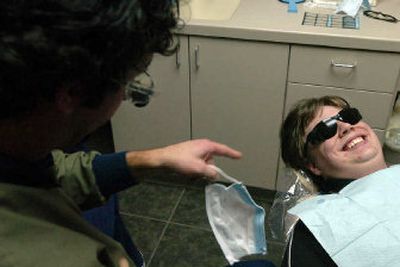
Beneath dentist Ken Bevan’s drill, 7-year-old Paige Neal was a trouper.
Faced with three fillings and two extractions in an hour Friday morning, the student from Atlas Elementary School in Coeur d’Alene tried to be brave.
“Ow,” she said, when Dr. Bevan put a clamp on an infected tooth. “Ow, ow!” she said when he eased it, gently, out of her mouth.
“You did great!” the dentist told Paige, who relaxed in relief.
Within minutes, the blond girl in pink-trimmed tennis shoes received a dose of children’s Tylenol and instructions to rest up for the afternoon.
Within days she should feel better, thanks to the “Give Kids a Smile Program,” a national effort that pairs volunteer dentists with kids who face obstacles to oral care.
By the end of the day Friday, Bevan and a half-dozen fellow Coeur d’Alene dentists expected to treat more than 100 children like Paige – kids with severe dental problems and little or no access to treatment.
It’s part of a program aimed at providing at least rudimentary aid to children who need it the most, said Bevan, whose office organized the event, the third for the region. “We’re just trying to fix these kids,” he said.
From early morning to late afternoon, dentists treated the worst problems identified in a recent screening at eight elementary schools with high populations of low-income children. They tended abscesses, filled cavities – as many as 16 in one mouth – and cleaned small teeth coated with plaque so old it had calcified.
Some children’s teeth had broken off at the gum line, an outcome of decay. Others required the equivalent of root canal procedures in their baby teeth. In one child, infection in a tooth had spread to the outside of the face, requiring hospitalization even before the event began, said Mary Jo Sauber, a public health dental hygienist with the Panhandle Health District.
In all, more than 1,000 first- and second-graders were screened under a $5,000 grant from the Coeur d’Alene Kiwanis Club. More than 200 were referred for care based on a simple flashlight screening. “We didn’t use X-rays or explorers,” Sauber said. “We just looked for the most obvious decay.”
For some children, the cause of their woes can be traced to neglect. “The parents didn’t take the child to the dentist,” Sauber said.
For most, the problem is more complex. Many families have no dental insurance or money to pay for dental work. Even families who receive government aid for care have a difficult time finding dentists willing to accept a medical card. Low reimbursements and sometimes spotty attendance are frustrating to dentists, Bevan said.
“Dental care is one of the biggest health care issues in this county,” said Beth Clemens, chief operations officer for the Dirne Health Clinic in Coeur d’Alene.
That center has begun offering very limited care for adults, she said. Soon, organizers hope to provide dental care for children, possibly as a Medicaid-funded program. Until then, many low-income families simply hope that dental problems don’t get too bad, Clemens said.
Paige Neal comes from a blended family with seven children, ages 4 to 18. Her stepfather, Ben Schaffer, 43, of Couer d’Alene, and mother, Rebecca Schaffer, 31, urge all their children to brush and floss, but getting them to the dentist is difficult.
Ben Schaffer, a mill worker, recently got a job at the Potlatch Corp. mill, where he’s waiting for his dental benefits to begin. Rebecca Schaffer works at a nursing home, but the premiums for dental insurance are too expensive.
Paige recently began complaining about sore teeth and a stomachache. A doctor prescribed an antibiotic to treat the illness caused by her abscessed teeth. Ben Schaffer said he and his wife are eager to learn how to prevent tooth decay. But until Bevans explained it Friday, Schaffer didn’t know that parents should help brush and floss their kids’ teeth until the children are 8 or 9.
“It’s just education, getting it out to the parents and teaching them,” Schaffer said. “You want the best for them, but sometimes you don’t know how to do that.”
What’s really needed, Bevan said, is widespread education, greater access to funding and community.
“I can’t believe in the year 2006 we don’t have fluoride in the water,” he said.
Coeur d’Alene doesn’t add fluoride to its public water supply. Fluoridation is controversial in many cities, even as most dentists and public health organizations say it’s necessary to prevent decay, particularly in children from low-income families. Opponents argue that fluoride is a toxic substance with potentially harmful health effects.
Small efforts like “Give Kids a Smile Day” do make a difference, one child at a time, said Cindy Perry, director of school health services for the Coeur d’Alene district.
“I think that since we started doing this, we have fewer complaints of kids with dental needs,” Perry said. “There might be a lot out there still, but the worst ones do get care.”