
Thrashers in hunt
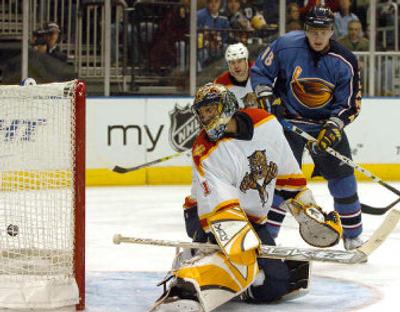
ATLANTA – Sure, it’s still February. Even so, the Atlanta Thrashers are doing plenty of scoreboard watching each night.
Did Toronto win? How about Montreal? What’s the Tampa Bay score?
“It’s exciting,” right winger J.P. Vigier said. “We’re in the hunt. We want to stay in the hunt as much as we can. Sure, we’re looking at other games. You want to know who’s winning, who’s losing and how it affects you.”
The Thrashers are three points out of a playoff spot in the Eastern Conference, an up-and-down franchise still trying to find its way in the NHL.
Atlanta entered the league in 1999 but never has made it past the regular season. The Columbus Blue Jackets, who joined the following year, are the only other team that doesn’t have a need for a playoff section in its record book.
This is certainly a crucial season for the Thrashers, who figured to be one of the biggest beneficiaries of the post-lockout NHL. The salary cap evened things up between the haves and have-nots. The new, offensive-minded rules played right into the hands of a team that has three of the league’s top-10 scorers (Ilya Kovalchuk, Marc Savard and Marian Hossa).
Also, this is year six for the Thrashers, more than enough time to build a playoff-worthy squad based on other expansion franchises.
Of the last nine teams brought into the league, starting with San Jose in 1991, seven have made at least one playoff appearance. The average time to get there the first time is four seasons, with Florida and Minnesota being the quickest (both made it in their third years) and Nashville the longest (season six).
“This is definitely a playoff team,” said Peter Bondra, one of the top career scorers in the league and playing his first season with the Thrashers. “There’s no question about that. It’s just a matter of how much we want it.”
Atlanta didn’t start out with much enthusiasm, losing 19 of its first 29 games. There was an ugly four-game skid in October, in which the Thrashers were outscored 22-2, and a season-high five straight losses at the beginning of December.
Then, suddenly, they started playing like the team everyone expected.
Atlanta picked up points in nine straight games (six wins, two shootout losses, one overtime loss). Kari Lehtonen, who missed most of the first three months with a severe groin injury, returned in late December to bolster the goaltending.
The Thrashers put together a five-game winning streak – the longest in franchise history – and surged into seventh place in the East. There was even bold talk about chasing down the first-place Carolina Hurricanes, who had jumped to a big lead in the Southeast Division.
Well, that subject faded over the past two weeks, as the Thrashers slumped and fell out of a playoff spot.
“This is the same team that put on such a good run,” coach Bob Hartley said. “We’re just not getting it done right now.”
Lehtonen’s health is crucial to any playoff run. The Thrashers also have 33-year-old Mike Dunham, but he’s been plagued by injuries and is no longer up to the role of being a No. 1 goalie.
Lehtonen is not nearly as far along in his recovery from the groin injury as might have been expected after such a long layoff. Already, he’s limited at practice and can’t play on back-to-back nights.
In a recurring theme from past seasons, Atlanta must tighten up defensively. Niclas Havelid, Jaroslav Modry and Greg de Vries were added to the back line, but the Thrashers still rank near the bottom of the league in goals allowed. They’ve been especially dismal at killing penalties – a skill that has taken on greater importance this season with the officials clamping down on the slightest infractions.
Still, the Thrashers are part of the playoff race. That’s a start.
“To me, it’s like we’re already in the playoffs,” Bondra said. “Every game is important for our position. We can’t relax at all.”