
On call at Olympics
The television commercial sets the scene:
Exterior, skiing venue
A female U.S. winter Olympian stands at the top of a course and appears anxious.
She is told to relax by a male advisor as she prepares to bomb down the hill in her quest for a gold medal.
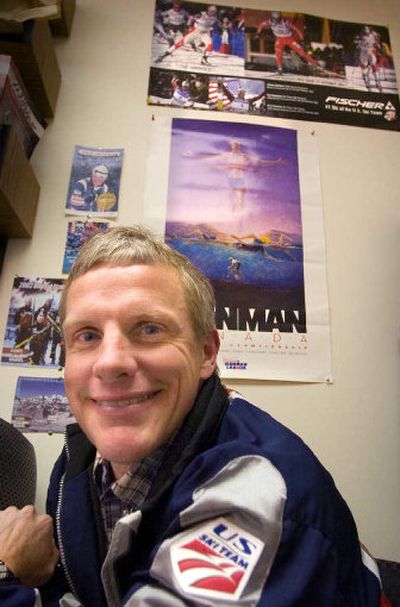
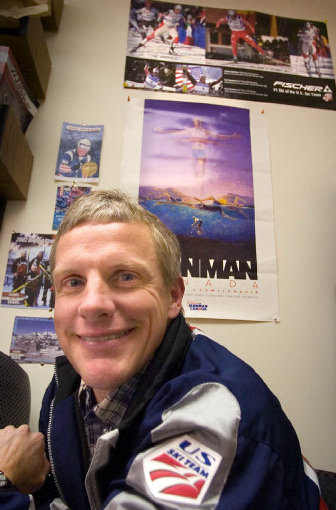
Well, it’s just television. But the athlete in the ad is a living, breathing, U.S. Olympian: snowboarder Lindsey Jacobellis. An actor portrays the team psychologist who eases her fears. In real life, Cheney’s Jon Hammermeister fulfills that role.
“The gist of it is to help the U.S. Ski team guys go faster,” Hammermeister said directly about his job.
Technically, Hammermeister isn’t assigned to the U.S. alpine teams. That may be a blessing, if you believe the hype about downhiller and self-admitted “bad boy” Bode Miller.
Hammermeister is an Eastern Washington University professor who serves as a paid consultant to the U.S. nordic teams (cross country, ski jumping and nordic combined) about 30 to 40 days per year. Among the foregoing disciplines, the cross country events are particularly mentally demanding.
“The biggest thing they have to watch out for is trying too hard,” he explains. “They can actually go slower the harder they try, because technique is so important.”
By contrast, the whole performance of the ski jumpers comes down to a fraction of a second at lift-off. It takes its own unique frame of mind and particular mental preparation.
It all means job security for Hammermeister, who will be in Turin for the duration of the Winter Olympics as the U.S. team sets its sights on a stated goal of 20 medals in skiing and snowboarding. He may be in demand.
That’s because the U.S. Ski and Snowboard Association (USSA) requested credentials from the U.S. Olympic Committee and the Turin Organizing Committee for three sports psychologists (two staffers and Hammermeister) to serve its seven teams, but only one was granted – to Hammermeister.
“So, it looks like I’m going to be a little busier than I originally thought,” said Hammermeister last week before Tuesday’s departure to Italy.
Specifically, the 45-year-old married father of two will provide tailored coaching to the nordic teams and will be available on an “as-needed” basis for the remaining ski and snowboard athletes. It’s a working vacation of sorts – emphasis on the working part, the vacation part actually being a misnomer.
Hammermeister will be living alongside his clients in Sestriere, a mountain-top village in the Alps along the French border, where the skiing events will be held. It’s located far from the hustle, bustle and glamour of the Olympic ceremonies in Turin.
The days on the job are long – 6 a.m. to 10 p.m. or later – and are filled with activities ranging from providing support at event sites to holding one-on-one and team sessions. Hammermeister knows the grind well because this is his second Olympics.
He was also on staff for the U.S team in Salt Lake City in 2002. In fact, the cross-country course at Soldier Hollow has a segment named after him, “Hammer’s Head,” an uphill portion of the course that seems an appropriate nod to a man whose job is to help athletes break through mental barriers and excel.
Hammermeister has been in the field of sports psychology for 10 years, seven of those at EWU. His tenure there is purely academic and research-oriented, but he still finds time to work with select outside athletic programs from his Cheney office.
Among his clients are former EWU men’s basketball coach Ray Giacoletti, now at Utah; the Vanderbilt men’s basketball program; the Spokane Chiefs hockey team; and, of course, the USSA.
Hammermeister began working with USSA athletes when they came through the fitness testing lab at Central Oregon Community College in Bend, where he was a professor in the late ‘90s. Soon he followed the teams around the globe for training sessions and competitions, including world championships.
He moved to Eastern in 1999 and now has athletes who “seem to find their way” to his office for advice. His undergraduate level classes are chock-full of current Eagles looking for a competitive edge in the Big Sky Conference.
In essence, Hammermeister is a Pied Piper of sorts for the field of sports psychology. His passion for the field was sparked during his master’s and doctorate studies at the University of Idaho.
Hammermeister believes in the science and said studies indicate a top athlete can boost performance an extra 3 to 5 percent by using mental training. He employs a variety of techniques in working with his clients.
A typical program starts with a foundation of consultations early in an athlete’s training phase that is centered on short- and long-term goal-setting.
From that point, review of those goals is just one of the necessary elements for success. An athlete is also shown how to hone skills in the areas of relaxation, motivation and maintaining focus under pressure.
Pressure increases closer to competitions – especially those high-profiles ones – and none occurs on a bigger stage than the Olympics. For many of the athletes, their entire competitive careers peak with an Olympiad.
“One of the main things is to help the athletes deal with competitive anxiety better,” he said. “They’re normal people who are just really good at a particular skill. They’re not immune from the emotions and stress of an Olympics.”
Legacies can be secured or lost depending on the outcome of a single event or one moment in time. The wealth of sponsorships available to those who seize the moment can create a lifetime of financial security.
“They have a chance to make themselves more comfortable for the rest of their lives,” points out Hammermeister.
Given all that, does the former collegiate tennis player and coach from the University of California (San Diego) feel his own performance anxiety? “No,” said Hammermeister.
He will simply do his part and judge his success on his own terms, a process-based one, knowing full well that he works in a results-oriented industry.