
Tankers may get funding boost
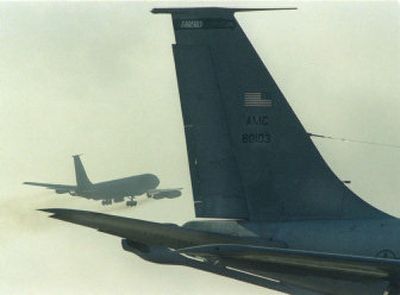
The Pentagon wants to spend about $204 million in 2007 to help the Air Force find a way to replace some of its aging air refueling tankers.
But the arrival of new planes to replace the KC-135s at Fairchild is still years away.
The money for research, development and testing of a replacement air tanker is included in the fiscal 2007 budget President Bush submitted to Congress this week. It’s more than twice the money set aside this year for finding a replacement for the workhorse of the Air Force tanker fleet, but members of Congress said they’re unsure how the Pentagon is planning to spend that money.
“We’re looking for detail,” said a spokesman for U.S. Rep. Norm Dicks, D-Wash., a high-ranking member of the House Appropriations Committee.
The budget proposal comes on the heels of a 13-month study by the Rand Corp. that says the Air Force should get some new tankers that are modified commercial jetliners.
That’s something Washington’s congressional delegation has been urging the Air Force to do since the fall of 2001, when members of the House and Senate tried to arrange a trifecta for the Evergreen State:
Keep a Boeing commercial airplane assembly line going.
Start replacing Air Force planes that are older than the pilots who fly them.
Put the first contingent of the new planes, along with a training facility, at Fairchild Air Force Base.
By 2003, Congress was poised to do all three by giving the Air Force the authority to lease 100 tankers that Boeing would build by modifying its 767 jetliner. The Air Force was planning to send the first 32 planes to Fairchild starting this year and spend up to $225 million to build a training facility at the West Plains base. But that was before Sen. John McCain, R-Ariz., objected that leasing the planes was more expensive in the long run than buying them outright, and a former Air Force official pleaded guilty to giving Boeing preferential treatment on the tanker deal in exchange for an executive position with the company.
Everything connected with the tanker replacement was grounded while the Pentagon was ordered to restudy how to replace the tanker fleet and how to pay for it. The Rand study, technically known as an analysis of alternatives for recapitalizing the KC-135 fleet, says the Air Force should ask commercial airline manufacturers to submit proposals for modifying one of their jetliners into a flying gas station.
That is exactly the way the Air Force has bought tankers for half a century: The KC-135 is a modification of the Boeing 707, and the KC-10 is a modified DC-10. It is also what Washington lawmakers were pushing in 2001, with one big change.
The Rand study said there are probably seven different airplane models that would be modified to fit the Air Force’s need. The Boeing 767, 777, 787 or 747 might work, the analysts said.
But so might three different jetliners built by Boeing’s major competitor, European-owned Airbus.
Sometime later this year, the Pentagon is expected to ask the manufacturers to submit “requests for information,” the first stage of the bidding process to say how much they would charge to redesign a jetliner, and what that plane could do.
On Wednesday, Defense Secretary Donald Rumsfeld told the House Armed Services Committee he was concerned about the tanker fleet.
“An aging fleet means increased maintenance costs and flight restrictions,” he said in prepared testimony.
There’s no timetable yet for testing, selecting and delivering those planes, but George Behan, a spokesman for Dicks, said it’s unlikely those new tankers will show up before 2010.
There’s also no cost estimate in the Rand study, but the planes will almost certainly have a higher price, thanks to inflation, he said, and the KC-135s they’ll be replacing by then will have an average age of 50 years, not 45.
Also unknown is where the first squadrons of planes, and the training facility to teach pilots to fly them, will be based.
Sen. Patty Murray, who was one of the main architects of the original proposal to lease Boeing tankers, is convinced that despite everything that has happened to the original plan, the location won’t change.
“It’s our expectation that the first tankers, when they come, will come to Fairchild,” Murray spokeswoman Alex Glass said.