
Old Ward building boasts rich, even eerie, history
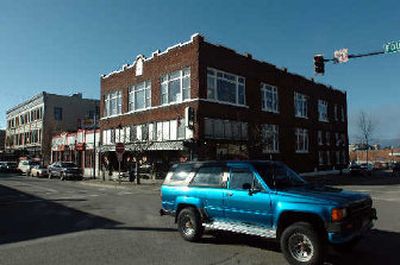

Jeff Gagnon, who with his mother, Williene, operates the Wiggett Antiques Mall, likes to talk about the building and the antiques business.
He will quickly tell you that the 27,000-square-foot brick-faced structure at 119 N. Fourth St., was built by J. W. Wiggett for Montgomery Ward and that the store opened for business in 1928. Wiggett had previously constructed a neighboring building which bears his name and still stands on the corner of Sherman and Fourth.
Gagnon also points out that the store is pretty much intact inside and out, and continues to use the same style of striped, green awnings that appear in early photographs of both the Wiggett building and the Ward’s building.
In answer to questions about the signs in the window, he says, “Yes, the building is for sale. The longtime owners, the Johnson family sold it two years ago to Californian Steve Groner who has it for sale again.”
Since the signs went up there has been much curiosity about the selling price. To answer that question, Gagnon and the staff have posted a sign listing the price.
The sign also says that, no, the business is not for sale, just the building, and that the restroom is in the back, follow the white footprints.
As for offers to buy, Gagnon says that one offer proposed tearing down the structure. “The land it sits on is very valuable.
“We have one more year on our lease and after that the monthly rent will quadruple,” Gagnon says. “If we don’t stay here we will find another location,” he said.
His family has a lot of history with the Ward’s store; his grandfather, Bill Pufal, worked there as a warehouse man until the corporation relocated to the Silver Lake Mall. Gagnon says that he considers himself a native, although he was born in Minnesota; his mother, a Coeur d’Alene native, moved back in 1972. The family has lived here ever since.
After Ward’s relocation, the building was occupied by the Home Furniture Mart and a gym. The antiques mall, which rents spaces to about 110 dealers, has been there for the past 18 years.
“When we first considered the place, The Two Swabbies also was interested but, because they wanted to tear out the central staircase, the Johnsons offered us the lease,” Gagnon says.
Longtime residents come in comment on how little has changed – even the narrow, maple floors squeak as they always did. Customers also remember the cable pulley that carried receipts and money back and forth to the mezzanine office located just above the front entrance. The original freight elevator, located at the rear of the store still is operable and carries cargo and customers who cannot climb stairs.
The staff says that one question that often comes up is the one: “Is it haunted?” They roll their eyes and mention “sounds” on the stairs, “… when you are alone in here at night.”
Gagnon urges Gloria Powell, who has worked at the Mall since its opening, to tell one story in regard to an occurrence during the last holiday season. “Our employees were having a Christmas party on the third floor,” he prompts.”
Gloria picks up the story: “We were having a good time, and someone decided to play the piano.”
The piano is a Kimball, upright, player piano with rolls, on consignment with a sticker price of about $3,000.
“All of a sudden,” Powell says, “We heard someone whistling along. None of us was whistling but every time we played the piano the whistling began.”
Employee Anne Harris, recalls the incident of the antique, rosette iron used to deep-fry pastry delicacies. A customer picked it up, examined it and then put it down. When she came downstairs to pay for some other items and reached in her purse she found that somehow the iron had made its way into an outside pocket of her purse.
Then there was the tea cart/glass jar caper. The tea cart stands in a dealer space at the top of the stairs on the mezzanine and has glass jars displayed on its top. One day, Powell and Harris watched as a jar, without help, fell onto the floor, rolled across the floor and down the stairs, where it stopped abruptly halfway down – all without breaking. They both shrug and raise their eyebrows, shaking their heads.
If there is a resident ghost, the consensus is that it is feminine, benign and more of a prankster than anything else. However, Gagnon does recall one creepy incident a number of years ago that involved a large cupboard that had arrived in a shipment from Europe.
“We opened the container and felt a real chill. Anyplace the cupboard was, it was always cold. Finally we put it outdoors and eventually sold it. We never brought it back in,” he says.
One might speculate that maybe someplace, someone is keeping beer cold in an antique wardrobe.
As for other unusual happenings, Gagnon says that hidden money, 3,000 pounds in British currency, was found in a piece of furniture, and an unopened, brown-stained, cellophane tobacco package may have contained baseball cards valued at roughly $30,000. Both had been sold by the time they were discovered.
With its ghosts, squeaks and all, Gagnon says he would like to stay in the building, which is eligible for placement in the National Register of Historic Places.
What makes it eligible? It is more than 50 years old, intact inside and out and is representative of a type of architecture classified as “transitional” – between Classical revival and Art Deco. It was a blueprint for all J.C. Penney’s and Ward’s stores, according to Gagnon.
Perhaps most important is that a sense of place survives with the building. The business that originally occupied the structure both shaped and was shaped by the community in which it was built and recalls a time when working people came down town to shop where they could buy clothing, jewelry, hardware, drugs, furniture or cars.
Thanks to the innovation of men like A. Montgomery Ward, they could pay for what they bought on time, often buying more expensive items for which they did not have the ready cash.
And today, as Powell points out, “It is possible that some of the things that actually were sold in this building have been brought back by our dealers to resell as collectibles and antiques.”
High on the front pediment of the Mall is a terra cotta relief showing a classically draped figure of a young girl – the embodiment of the Ward’s logo, “The Spirit of Progress” – recalling a time, much like the present, when the only direction imaginable was forward.