
A film force

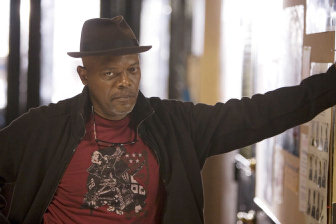
An acknowledged workaholic who always seems to have a movie out, Samuel L. Jackson has played everything from a junkie to a cop to a Jedi knight.
The 57-year-old Jackson is outspoken and street-smart, a Morehouse College graduate whose conversation is peppered with street slang and tinged by a healthy dose of attitude.
He’s due in Spokane next month to start shooting “Home of the Brave,” a drama about three returning veterans of the Iraq war.
Starting today, you can see him onscreen in “Freedomland,” in which he plays a North Jersey detective trying to keep the peace at an urban housing project after a woman accuses a black man of a crime
Sitting in a New York hotel ballroom to plug the film, he wears his ever-present Kangol hat. His face is so familiar, his voice so recognizable, that he seems like a neighbor or a co-worker. The bristling annoyance that sometimes lingers beneath what he says is almost tangible.
“Freedomland,” based on a Richard Price novel, is something he’s been “running away from” for six years. Jackson finally signed on when Julianne Moore was cast and his own character became less of a “facilitator” and more of a protagonist.
Asked if he’s ever been the victim of racial profiling, Jackson answers evenly: “If you grow up black in America, that happens.
“There was a time in the ‘60s when I was pulled over in the car because I had a big Afro and wore a wraparound T-shirt,” he recalls. “There was a time when I was in Atlanta and I was pulled over because I was driving fast and had a big Afro.
“I was never roughed up but just before ‘Pulp Fiction’ came out (in 1994), I was doing a play in Santa Monica and I just had dinner at a place down there called Hugo’s. I was standing on a street corner with four or five friends and five sheriff’s cars pulled up and had us to lay face down in the street. Somebody had called up and said there were five black guys standing around with guns and bats.
“One of the cops said to me, ‘I’ve seen you before.’ Now, when a cop says that to you it can be good or bad: He may think he saw you in a lineup before.”
As a result, Jackson said he has his own rules of behavior in front of police: Don’t make any sudden moves; don’t make any smart remarks; and continue to say, ‘Yes, sir.’ “
He also has his own work ethic, one that is appreciated by his director and co-stars.
Joe Roth, the Revolution Studios chief who directed “Freedomland,” calls Jackson “the most prepared professional actor I’ve ever worked with, bar none. Sam suffers fools not at all.”
Co-star Moore, who plays the tortured mother who claims a black man roughed her up and stole her car with her son in it, says she found a soulmate in Jackson, who has the same approach to acting she does.
“He was on the set and there were lots of jokes. He was talking to the crew and he just got right back into the scene,” she recalls.
“Finally, my makeup person said, ‘I think you’ve met your match.’ I’m a little chatty and we kept talking and everything. I love him. I adore him.”
What Jackson found in Moore was a solid actress who had a life outside film – a life that includes an obsession with “American Idol.”
“There are people who work like I work. They do all the stuff they have to do at home before they get to work,” Jackson says.
“Julianne was all caught up in ‘American Idol’ and then she’d cry for a scene and go right back to talking about `American Idol.’ It was refreshing to me.”
Set in a fictional New Jersey town, “Freedomland” actually was filmed at the Mulford Gardens housing project in Yonkers, N.Y.
Roth said New York offered a 15-percent rebate on services and the Jersey City projects Price wrote about had been torn down.
Jackson, who was born in Washington, D.C., and raised in Chattanooga, Tenn., believes people associate housing projects with two things: blacks and high crime.
“The majority of people there are hard-working,” he says. “They’re economically challenged. They’re only human. You push them and they push back.”
Since he launched his career in 1972, Jackson’s 90-plus films have earned $3.8 billion worldwide in box-office receipts, and he has a star on the Hollywood Walk of Fame. But the honors did not come easily.
He was once a doorman at a subsidized apartment building in New York, and a stand-in for Bill Cosby on “The Cosby Show.” He burst into moviegoers’ consciousness playing a junkie in Spike Lee’s “Jungle Fever” (1991), a role he assumed only two weeks after completing rehab for a cocaine habit himself – winning a specially created supporting actor award at the Cannes Film Festival.
Jackson’s performance as Jules, the hit man-philosopher of Quentin Tarantino’s “Pulp Fiction,” made him a star, earning Oscar, Golden Globes and Screen Actors Guild nominations. He won the New York Film Critics’ and Independent Spirit awards for the role.
His resume also includes the likes of three “Star Wars” installments, “The Incredibles,” “XXX” and the 2000 version of “Shaft.”
An avid golfer who’s been married to actress LaTanya Richardson since 1980, Jackson doesn’t pretend he’s interested only in deep dramas or potential prize-winning movies.
“I’m still that guy who likes to see myself in something mindless and exciting,” he says. “I don’t want to do heavy movies all year long. I want to do films people scream at.”
To demonstrate, he lets out a blood-curdling scream.
“That’s why the next picture I’m (releasing) is ‘Snakes on a Plane,’ ” he says.
Jackson, who averages three to four films a year, isn’t kidding. Look for “Snakes on a Plane” – about exactly what the title says – in theaters this August.