
Making e-waste disposal free

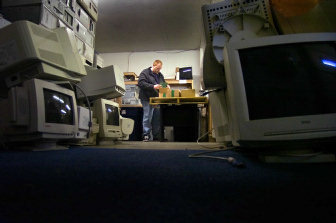
Instead of paying to get rid of an old computer or TV set, Washington residents could recycle those items at no cost if a bill moving through the Legislature reaches the governor’s desk.
By a 41-to-8 vote earlier this month, the state Senate approved the bill that would create Washington’s first statewide electronic products recycling program.
House lawmakers are expected to vote on a similar measure next week.
Backers of the bill say it would mark a major step in handling and properly disposing of tons of old computers, monitors and TV sets. The bill does not include printers, cell phones or other products.
Opponents include a number of major electronics manufacturers, who view the plan as creating an uneven playing field in their industry.
Like everywhere else in the United States, Washington residents are trying to deal with vast piles of old equipment and computer parts, either by dumping them on charities or paying to dispose of them.
A Department of Ecology report estimates that between 2005 and 2010, Washington will be dealing with the disposal of 5 million computer boxes, 3.5 million cathode ray tube monitors, and 1.5 million flat panel monitors.
If the bill becomes law, the state would require manufacturers of those products to pay for handling, processing and transportation of recycled products based on a formula that tracks how much of the waste stream each company creates.
Two large electronics manufacturers, Dell and Hewlett-Packard, back the bill, as does the Washington Retail Association, which represents 2,800 state retailers.
“This is a simpler way to deal with the problem,” said association President Jan Teague. “In California, where the state added a tax at the point of sale, we’ve heard it’s created a nightmare” of varying fees and surcharges, she said.
Currently, individuals or companies pay between $2 and $25 in “take-back” fees when they deliver used equipment to companies or charities that handle the products.
Under the proposal, the state would set in motion an annual “waste audit” to determine the share of products that comes from each manufacturer. The manufacturers then would pay a proportional share to cover costs of handling, transporting and disposing of those items.
Vinay Goel, a spokesman for Cupertino, Calif.-based Apple Computer, told House members that Apple approves of state-based recycling plans. “We would prefer a national solution, but since that won’t happen soon, we back efforts such as this one in Washington,” he said.
Apple Computer officials, however, view the Washington plan as creating a system that places an unfair share of costs on longstanding companies instead of those that have just entered the market.
Randy Ray, an Olympia-based lobbyist for a manufacturers group that includes Sony, Sharp and Panasonic, echoed that concern.
Ray said the proposal would allow newly started companies to avoid recycling costs because their products won’t show up in the waste stream for several years. “Many of them go out of business after a few years anyway, because they don’t sell products based on brand. They sell, through large retailers, solely on their low price,” he said.
Efforts to get environmental and retail groups to modify the proposed cost formula have not been successful, said Ray.
Mo McBroom, the policy adviser for the nonprofit Washington Environmental Council, said the goal was to start small and “work out the kinks first.” Other equipment, such as cell phones and printers, potentially could be added to the program later.
In Spokane County, residents pay a dumping fee based on weight when they take computers or TVs to transfer stations or the Waste-to-Energy Plant on the West Plains.
Dennis Ford, owner of Spokane-based Inland ReTech, an electronic component recycler, said he likes the general provisions of the proposal. His company has two drop-off sites – one near downtown Spokane and another in Spokane Valley. The bill, if it becomes law, would stop him from charging people to take their TVs and computers if he takes part in the state-payment system.
McBroom said the proposal before Washington lawmakers is a cost-effective system that’s better than the retail tax approach taken by California.
“Under this plan, instead of paying for the problem at the end of the product life, it will be wrapped into the product price,” she said.
The state’s monetary obligation would not be significant; the bill would create four jobs to help track the volume of waste produced in the state and help coordinate payments to haulers and product processors.