
U.S. so-so at halfway point
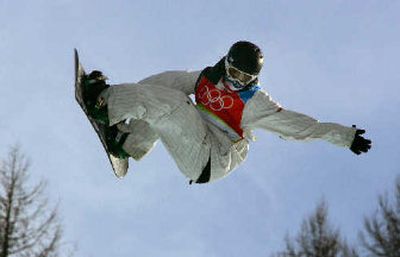
TURIN, Italy – In that gasp of a moment, Lindsey Jacobellis went from golden to ruins, flying through the air with a snowboarder’s twist, then suddenly tumbling to the ground.
The image of Jacobellis letting certain victory slip away in an Olympic snowboard race last week might seem a metaphor for the U.S. team.
The American squad has suffered one high-profile gaffe after another at the Turin Games.
Bode Miller has skittered to defeat in his first three ski races. An injured Michelle Kwan had to withdraw before the start of figure skating. Even the U.S. women’s hockey team, historically a lock to make the gold-medal game, fell short.
Yet, with many of its stars floundering through the first week of competition, the U.S. team remains on pace to have its second-best Winter Olympics and meet what experts consider to be an impressive medal count.
“We feel good about where we are,” said Darryl Seibel, a U.S. Olympic Committee spokesman. “We’re up there with perennial Winter Olympic powers.”
Through Sunday, the Americans ranked behind only Norway and Germany with 13 medals. They are tied with Germany for most golds with seven.
If their performance has seemed disappointing, it might be because they arrived in Turin under the weight of heightened expectations, thanks to an unprecedented haul at the 2002 Salt Lake City Games.
The team came away from those Olympics with 34 medals, a quantum leap from its previous high of 13 in 1994 and 1998.
A large part of the 2002 success could be attributed to the idiosyncrasies of winter sports, in which the home team benefits from crowd support and familiarity with conditions.
All regulation indoor basketball courts have wooden floors with 10-foot hoops at either end. But each mountain is different, with different slopes and types of snow, and each outdoor sliding course has unique characteristics.
So the USOC, despite hiking its budget 10 percent to about $36.5 million for Turin, declined to make any predictions before these Olympics. It was left to sports experts to declare that the team needed to win 25 or more medals to show continued improvement.
That message got through to the athletes.
“As much as we tried to downplay it, there was no denying the pressure,” said Bud Keene, a U.S. snowboard coach. “We talked about it.”
Things got off to a bad start with Kwan’s withdrawal from women’s figure skating. Shortly thereafter, Johnny Weir put himself in position to finish among the top three in the men’s competition only to botch his long program. He blamed a lack of inner peace and a malfunctioning aura.
The U.S. wasn’t doing any better in another top winter sport – Alpine skiing.
On the second day of competition, Miller finished fifth in the downhill. Though his time was only 0.11 of a second short of the podium, it was a failure in a marquee event.
Perhaps the most-scrutinized athlete of these Games, Miller subsequently missed a slalom gate while leading in the combined and, on Saturday, veered out of control after hitting another gate in the super-G.
Daron Rahlves, a fellow star on a ski team that bills itself as “Best in the World,” also had problems.
“It’s pretty poor right now,” Rahlves said. “I think (the men) should have been able to medal in every event.”
But even as top female skier Lindsey Kildow suffered an injury during a practice run, the team got an unexpected lift when Ted Ligety came from behind to win the combined. He is the only U.S. Alpine skier – male or female – to reach the podium so far.
Snowboarding has fared much better.
Keene, the coach, admits to being worried when he saw Shaun White, a favorite in the men’s halfpipe, grow nervously quiet before the event. And when he noticed anxious body language from Hannah Teter, his top rider in the women’s halfpipe.
Both came through with gold medals.
In the men’s moguls, Toby Dawson nailed two 720 aerials to win bronze. American speedskaters Chad Hedrick, Joey Cheek and Shani Davis won gold in rapid succession.