
U.S. ice dancers mine silver
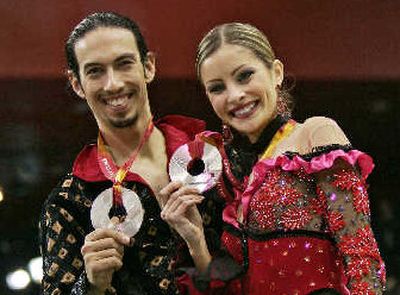
TURIN, Italy – Seven weeks ago, Tanith Belbin was a Canadian citizen. Monday, she stood upon the Turin Games podium and watched the American flag rise in her honor.
Belbin and partner Ben Agosto ended an era of futility, becoming the first U.S. ice dancers in 30 years to win an Olympic medal.
Belbin and Agosto earned second place with a robust, romantic performance to flamenco music. Synchronized skating got them the silver medal, but a passport scramble as furious as their footwork got them to the Winter Olympics.
As recently as Christmas they had given up hope of competing in Turin, even though they are the No. 2 ice dancing couple in the world.
“When we saw the flag going up, it was a sight we had not prepared for because we didn’t want to create a dream we couldn’t obtain due to reasons out of our control,” Belbin said. “We felt pressure from ourselves, to prove we were destined to be here.”
Belbin and Agosto thanked their coach, also a naturalized U.S. citizen, and the American ice dancers who paved the way in a discipline of figure skating vilified for predetermined results that favor Russian skaters.
But Sen. Carl Levin (D-Michigan) can also take some credit for the silver medal. He lobbied for the immigration amendment that shortens the citizenship process for “applicants of extraordinary ability.”
The measure was signed by President Bush on Dec. 30 and Belbin was sworn in New Year’s Eve.
Belbin, a native of Quebec, has been living in Detroit since 1998, when she paired with Agosto after going through five previous partners. She got her green card in 2002 and did not expect to become a citizen until 2007, after the usual five-year waiting period.
But Levin helped Belbin untangle red tape by accelerating naturalization for people who applied before the law was streamlined in 2002.
Belbin and Agosto’s breakthrough was only part of the drama at the Palavela, where Russians Tatiana Navka and Roman Kostomarov won the gold with a daring and dramatic dance to Carmen.
The sellout crowd was anxious to see if Italians Barbara Fusar Poli and Maurizio Margaglio had reconciled after their Sunday spat. Near the end of their original dance, he tripped, dropped her and fell on top of her. It was an inelegant fumble in a discipline in which falls are as rare as understated costumes. When the music ended, Fusar Poli, hands on hips, glared at Margaglio for 31 searing seconds. In the kiss and cry area, she buried her head in her hands, crossed her legs in disgust and didn’t look at him.
But after their free dance, which left them in sixth place, they hugged, kissed and appeared to make up.
Belbin and Agosto made small mistakes in their circular footwork and twizzle sections, but held on to second place.
They won their medal under a new scoring system implemented in part to break the gridlock and collusion in ice dancing, which was part of the vote-swapping deal that led to the pairs scandal at the 2002 Olympics. Skaters from the former Soviet Union have won seven of the past 10 world titles and 15 of the 24 Olympic ice dancing medals awarded since the discipline was added to the Olympics in 1976. Since Colleen O’Connor and Jim Millns won the bronze 30 years ago, no Americans have been able to crack the top three at the Olympics.
“We knew there were seven or eight teams with a chance of making the podium, and the new system allows for unpredictability,” Agosto said. “I feel this medal belongs to a lot of people who built the sport in the U.S. and weren’t able to break through.”
Agosto, 24, of Chicago, was asked if Belbin, 21, seems American to him.
“She’s absolutely the perfect partner for me,” he said. “She’s made it clear to me it doesn’t matter where you come from as long as you get along.”