
Dysfunction Junction
When it comes to “Cat on a Hot Tin Roof,” even the characters’ names are part of our cultural consciousness:
Brick.
Maggie the Cat.
Big Mama.
Big Daddy.
Gooper.
Skipper.
And Skipper never even appears in the play.
Tennessee Williams’ 1955 classic is embedded in our cultural memory, partly as the result of a series of high-profile revivals, including:
“The 1958 movie version starring Elizabeth Taylor, Paul Newman and Burl Ives.
“A 1976 TV version starring Natalie Wood, Robert Wagner and Laurence Olivier.
“A 1985 TV version starring Jessica Lange, Tommy Lee Jones and Rip Torn.
“A 1990 Broadway revival starring Kathleen Turner and Charles Durning.
“A 2003 Broadway revival starring Ashley Judd, Jason Patric and Ned Beatty.
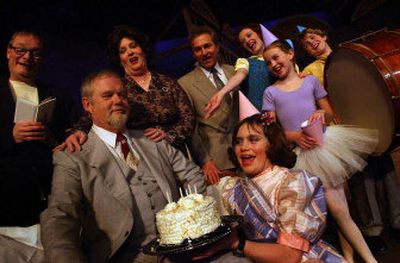
On Friday, the Spokane Civic Theatre launches its own revival, featuring Chasity Kohlman as Maggie, Damon C. Mentzer as Brick, Lauren Bathurst as Big Daddy and Jean Hardie as Big Mama.
Director Jessica McLaughlin was happy to sink her teeth into this classic story.
“I studied Williams in grad school and fell in love with the poetic imagery he was able to create in such a simple way,” said McLaughlin. “And the actors have such a great time with it. It’s devastating and humorous all at the same time.”
Her cast will tackle the intense story of the Pollitt family, which owns a plantation in the Mississippi Delta.
This family is loaded with what we would today call “issues.” Brick is an alcoholic. His wife Maggie had an affair with Brick’s best friend, Skipper. Skipper is a homosexual. Maggie declares she is pregnant. Big Daddy is dying and threatening to disinherit Brick.
To say “messy family tragedy ensues” would be an understatement.
This all started with the brilliant and controversial Broadway version in 1955, starring Barbara Bel Geddes, Ben Gazzara and Ives. It combined Williams’ two favorite themes, which the “Oxford Companion to American Theatre” defined as “Southern decadence and homosexuality.” It might be more accurate, however to define his favorite theme as the bottomless human penchant for self-delusion.
“The playwright doesn’t blame people for what existence does to them,” wrote New York Times critic Frank Rich of the 1990 revival. “He has empathy for the defeated and admiration for those, like Maggie, who continue to fight for life and cling to the hot tin roof ‘even after the dream of life is all over.’ “
Williams wrote several different endings to the play, including a slightly more optimistic one which was used in the original Broadway production. That is the ending that McLaughlin is using.
Williams arrived on the theater scene in 1945 with one of the enduring American statements on the theme of self-delusion, “The Glass Menagerie,” in which Amanda Wingfield dreams of handsome gentleman callers.
That was followed by “A Streetcar Named Desire” (1947), “Summer and Smoke” (1948) and “The Rose Tattoo” (1951).
“Cat on a Hot Tin Roof” came at the height of Williams’ fame and powers. Critic Brooks Atkinson called it “the work of a mature observer of men and women and gifted craftsman.” It received the Pulitzer Prize for Drama.
The Civic cast also includes Caryn Hoaglund, Paul Huck, Katie Nave, Jacob Newell, Kelly Kopczynski, Gary Pierce and Kim Berg.