
Take a chance on ‘Mia’
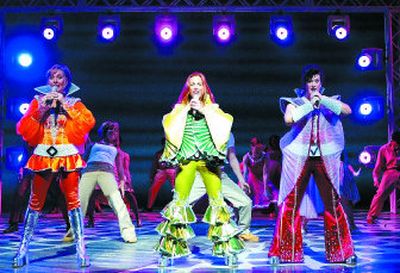
That’s entirely fitting for a show that has gone on to become a massive international smash.
The ABBA musical, which opens at the Spokane Opera House on Tuesday, has 11 productions around the globe – including the original in London, which has been running since 1999, as well as the Broadway show, in its fourth year.
It’s also playing in Las Vegas, Madrid, Osaka and, naturally, Stockholm.
London was the birthplace of “Mamma Mia!” but Stockholm is its spiritual home. ABBA came out of Sweden in 1974 to begin a run of international No. 1 hits including “Waterloo,” “Dancing Queen,” “Take a Chance on Me” and “Winner Take All.”
Those songs, and many other ABBA hits, comprise the score to “Mamma Mia!” This show was on the leading edge of the musical trend of taking pop songs by beloved artists – the Beach Boys, Billy Joel and Elvis, for instance – and fashioning a story around them.
The Beach Boys musical flopped, partly because the story was such a stretch. “Mamma Mia!” has been a massive success, partly because the story hit the right balance – at least if the marketplace is the judge.
It’s about a free-spirited single mother, Donna Sheridan, a former ‘70s pop singer who runs a small Greek resort. Her daughter, Sophie, is about to get married. One day, Sophie learns from her mother’s diary that her father could be any of three different men. She invites all three to the wedding and tries to discern the truth.
“I think they (the writers) had the right approach, which was to include the songs in the story and have them make sense,” said Bekah Nutt, who plays Sophie. “They’re sort of lucky – these songs just fit. And the songs are so theatrical in the first place.”
ABBA’s songs, by the songwriting team of Benny Andersson and Bjorn Ulvaeus, have always been known for having strong dramatic elements. This undoubtedly made playwright Catherine Johnson’s job easier.
Also, part of the fun of “Mamma Mia!” is discovering the clever way that Johnson sets up these familiar songs.
“They weren’t afraid to make the audience feel as if they were in on the joke, a kind of wink-wink to the audience,” said Nutt, by phone from a tour stop in Bakersfield, Calif. “The audience enjoys seeing how the puzzle is put together.”
As much fun as the story is, Nutt said there is no question about the show’s main appeal.
“First and foremost, the music,” she said.
Anyone listening to pop radio in the 1970s already knows about ABBA, but others might need a brief refresher.
ABBA came out of Sweden in 1974 to win the prestigious Eurovision Song Contest with “Waterloo.” Over the next eight years, the group had a run of hit singles in Europe that rivaled the Beatles and Elvis. In the U.S., it had 10 songs in the Top 20.
The name ABBA came from the initials of the members’ first names: Agnetha Faltskog, Benny Andersson, Bjorn Ulvaeus and Anni-Frid Lyngstad. Their harmonies and melodies were distinctive and instantly recognizable.
“We were not forced to sit down and listen to the original recording and told to sing it like that,” said Nutt. “Yet overall, we do attempt, as solo singers, to be true to the songs and sing them as written. The orchestration is the same as in the original songs.”
Nutt said many people in the audience know the songs by heart. But not everyone.
“Even if you are not familiar with the songs, they are just really well-written songs,” said Nutt.
This Equity (union) tour of “Mamma Mia!” travels with nine musicians and a cast of about 30. It has played 75 cities so far, and is booked well into 2007.