
THE COLLECTOR
Dear Collector,
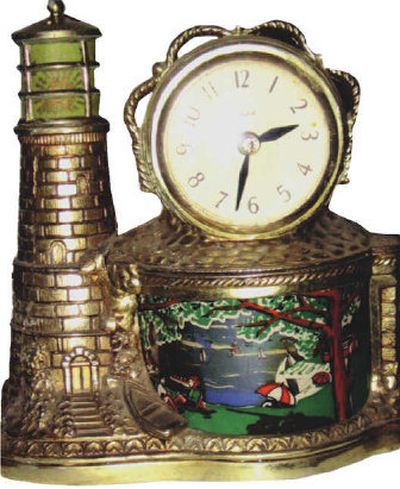
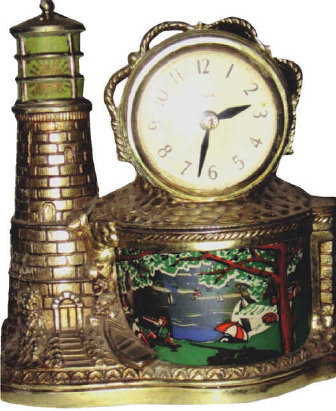
My aunt gave me this unusual lighthouse clock made by United Clock of Brooklyn. It runs great; what is it worth?
This 1950s motion clock with lighted revolving base was probably cast from “pot metal,” an alloy consisting of tin, lead, and antimony or copper. The maker, United Clock, also produced a series of novelty items such as the popular covered wagon model, and figural clocks including one of the famous boxer Joe Louis. Your keepsake is now valued at more than $200.
Dear Collector,
I inherited a painting of a “View of Mt. Morris” by T.H. Hotchkiss from my mother. I have searched the Web and could not find any information on this artist; I hope you can tell me something about him.
Born in New York State in 1834, Thomas Hiram Hotchkiss would fall victim to tuberculosis at Taormina, Italy, when he was 35. A landscape artist, he was a member of the American National Academy. Mount Morris, a village in the Genesee Valley’s Wyoming County, was a favored site for American artists of the mid-19th century. Since a Hotchkiss painting sold at auction in 2002 for more than $16,000, I suggest that you have yours appraised by a competent expert.
Dear Collector,
Does this “Life Goes to War” illustrated book have any value?
Since THE COLLECTOR does not comment on pre-1970 items, I’ll have to take a pass on your copyright 1977 book.
Dear Collector,
I have a Central Bank of Egypt 25 piastres; what is the collectible value?
Replacing earlier National Bank bills in 1961, your note is worth 4 cents if converted into U.S. currency or 25 cents to a numismatist (money collector).
Dear Collector,
I asked a friend about this leather object, and he said it is a kneepad used by soldiers a long time ago. I can’t get it to fit, so I don’t see how it would protect a man’s leg. What is it?
Thanks to my 1902 Sears, Roebuck catalog (and your excellent photographs), I found your item to be a horse boot, in particular a “cross firing pacers’ quarter boot.” Meant to reduce injury to a horse’s hoof, boots are still in use today, though plastics and synthetic materials have replaced leather and metal.
Dear Collector,
I was hoping you could give me some information on a pepperbox pistol marked “R-C?”
Sounds like you misread the marking used by Blunt & Syms, a New York City maker of firearms during the second quarter of the 19th century. Often stamping the letters A-C into the end of a gun’s barrel, this firm made several varieties of an under hammer multiple barrel pistol in a number of calibers. Depending on condition, model type, caliber and amount of original finish, these odd looking but deadly weapons are now worth from several hundred to well over $1,000.