
Milfoil concerns on minds of Legislature
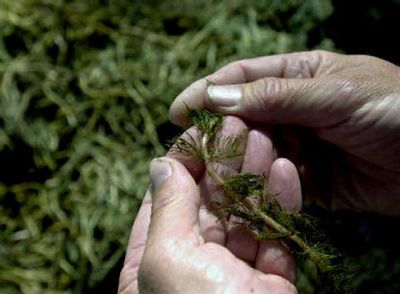
BOISE – What began as a minor noxious weed infestation is quickly spreading around Idaho and becoming an epidemic that lawmakers learned Thursday could cost as much as $12 million to address.
Eurasian milfoil has infiltrated lakes, especially those in North Idaho, state officials said. At Hayden Lake, 18 percent of the surface area is infested with the invasive aquatic plant, Matt Voile, noxious weed program manager for the Idaho Department of Agriculture, told the Senate Agricultural Affairs Committee.
The plant grows underwater and is difficult to detect until it breaks the surface, forming a dense layer that can entangle swimmers and cause boat wrecks. The weed also deprives the water of oxygen, which can hurt fish.
“It’s the silent monster in the noxious weed group,” said Rep. Eric Anderson, R-Priest Lake, who’s leading an effort to get more money and government attention to fight the weed. “It’s probably the biggest environmental hazard to this state that exists today.”
The state Agriculture Department is drafting a new rule to reclassify Eurasian milfoil as a water-borne noxious weed – a move that would expand treatment options for the state Department of Environmental Quality. Eurasian milfoil would be the only water-borne noxious weed in Idaho, which could help raise awareness of its dangers, Anderson said.
Of the 650,000 acres of water surface in Idaho, 250,000 are considered highly susceptible to the weed, Voile said. Infected waters include areas of Hayden Lake, Lake Pend Oreille and the southern end of Lake Coeur d’Alene. Many Eastern Washington waters are infected as well, including dammed portions of the Pend Oreille River.
The plant can spread to new water bodies via wind-blown spores or boats that carry it from one lake to another, he said. As little as three-quarters of an inch of the weed can start a new infestation in a lake.
Money is the biggest obstacle to fighting the invasion, Anderson said.
“We don’t need to reinvent the wheel. The solutions are already provided for us,” he said.Washington and other states have been unable to eradicate the weed, seeking instead to keep it under control.
Sen. Joyce Broadsword, R-Sagle, who serves on the agriculture committee, said she and others are talking about reinstating a $1-per-tire tax to raise the money needed to fight the problem.
Eurasian milfoil has been a problem in the Midwest for 20 years, and herbicides are available to fight the weed, Anderson said.
Voile described other control strategies in his presentation. But Anderson said the problem is so big in many Idaho lakes that methods such as diver dredging – that is, having divers physically remove the weed – won’t get the job done.
Voile estimated chemical treatment would cost between $200 and $1,150 per acre. Diver dredging would cost $200 to $900 per day for divers and boats, he said.
Waiting to act will push the price tag higher, Anderson said.
“If it’s a $12 million project today, in three years it could be $60 million if we don’t do something,” he said.
Allowing the infestation to continue could devastate Idaho’s economy, the officials said. The state’s recreation industry brings in about $2.3 billion a year, and “there is not a whole lot of recreation … that is not attached to this particular resource, which is our beautiful and pristine waters in the state of Idaho,” Voile said.
Anderson said property values could drop if the weed inhibits use of nearby lakes.
“We have to do something this year,” he said. “It’s going to be explosive.”