
Rare visitor
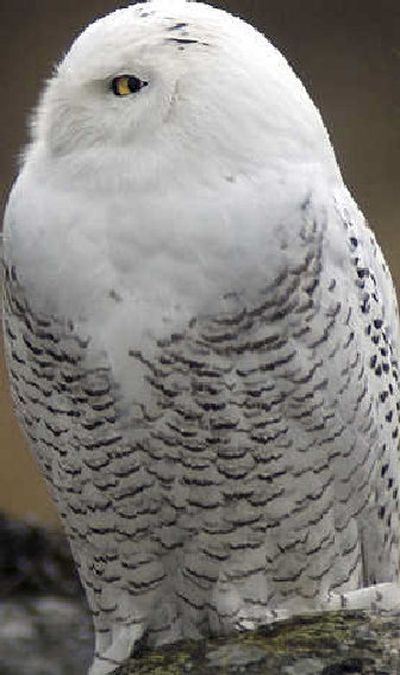
For the first time in years, we have a rare visitor in our midst. Ghostly when flying, stuffed animal-like when perched, a snowy owl from the arctic is again spending a part of his winter vacation with us.
It has been four years since the last confirmed snowy owl visited the Rathdrum Prairie, and it was five winters before that when one was seen for several months at the Coeur d’Alene Airport. So, as popular of a tourist destination as Coeur d’Alene has become, it’s still not on the snowy owl top 10 list.
Just about every year, it seems, Washington has its regular snowy owl visitors. The Moses Lake area and Lincoln County are pretty much annual destinations for owls seeking to avoid the hardships of arctic winters. But some winters are worse than others, and this seems to be one of them.
In the past two months, snowy owls have been seen as far south as Oregon on the coast, and Walla Walla in the interior. The Seattle area is a regular hot spot of snowy reports and the stretch west of Spokane, between Reardan and Davenport, is as close to a sure thing as there is for finding snowy owls.
So, from the standpoint of seeing a rarity, snowy owls are special. But what an exquisite bird! Even if they were perched in your front yard every day, you’d have to pause in awe of its beauty. How could you ever simply grow accustomed to having such a thing around?
They are so white, and so fluffy looking – right down to their toes, which you can’t see because of all the white fluffiness. Their golden eyes are so small in that perfectly round face. And it’s as if they don’t even have a mouth, there are so many white fluffs around their beak.
As with all owls, they don’t appear to have a neck. That snowball of a head just swivels around as if on ball bearings. To me, they also give the impression that there would be no weight to the body underneath the fluff. However, that’s not true.
At 4 pounds, snowys are our heaviest owls. Great gray owls are longer, but weigh less than half that of a snowy. And a great horned owl weighs less by at least a pound. It should be called the “great snowy owl,” or the “great white owl.” This latter name would appropriately associate the snowy owl with the great white shark. All owls are ferocious, but with its bulk, a snowy attack from within its breeding territory would, and does, leave a hapless human on the ground with a bloody, holey head.
The one that has taken to hunting the Rathdrum Prairie this winter is probably an immature male. All snowys have a white head, but adult males are almost pure white, and seldom venture this far south. Females have a smaller white bib and a lot more black barring, and likewise are less likely to leave Canada.
Adult females are the largest and most dominant, and are usually found the farthest north in winter. Adult males and immature females cover the middle territory, with immature males taking what’s left. That’s what we usually see down here. This year’s Walla Walla bird, however, is described as almost black and is most likely an immature female.
It has been long believed that snowy owl visits to the lower 48 states, called irruptions or invasions in migratory terms, are caused by crashes in the lemming populations far to the north. Lemmings are the large hamsterlike mammals that, along with arctic hares, make up the majority of a snowy’s diet during the breeding season.
Research has shown, however, that snowy owls eat lots of other things, too – including birds up to the size of small geese, any mammal to the size of a fox and even fish. They can snatch fish from the water like an osprey or, as one observer found to his amusement, a snowy can lay on its belly on a rock and snag passing fish with its beak as it peers over the edge.
A surprising number of snowy owls winter on or near the coast, especially in British Columbia. These owls feed primarily on sea birds such as grebes and alcids but also take a lot of ducks and geese. At this time of year, snowys on the plains of Alberta are eating lots of gray partridge along with their staple diet of mice and voles.
Our local visitor has been seen stalking both partridge and pheasants. And by the number of red-tailed hawks, rough-legged hawks and American kestrels on the prairie this winter, there are plenty of voles to go around, too. It’s a good thing. A snowy owl requires about a dozen mice and voles a day to meet its nutritional and energy needs.
If snowy owls aren’t tied as closely to their lemming diet as once thought, then what prompts these routine but unpredictable visits south? No one knows, but it’s beginning to look as though severe weather may be one of the several factors. However, snowy owls just naturally love to travel.
Years ago a nest full of baby snowys was banded somewhere in Canada’s arctic north. Within three months one had been found far to the east. Another was found equally far to the west. And a third was found in Siberia. These guys obviously wanted to get away from home in a hurry, and had quite different ideas about where to go to seek fame and fortune.
As I mentioned, some years are better than others for finding snowy owls. True migration is an annual cycle of movement. Irruptions are unpredictable. The largest West Coast irruption of snowys in recent history was in the winter of 1973-1974. In that event I saw my first – and almost my last – snowy.
I was driving south on Oregon’s I-5 from Portland to Eugene, idly counting red-tailed hawks on the fence line along the freeway. You can often get more than 50, by the way. On the large green sign announcing the upcoming Corvallis exit I saw a snowmanlike hawk that I knew in an instant to be a snowy owl.
In that instant I went from 70 – or whatever the speed limit was in 1973 – to zero, as I swerved out of traffic and onto the emergency parking strip. This was indeed an emergency, and at that point death would have been preferable to missing what I expected at that moment to be a once-in-a-lifetime sighting. At that point in my young birding career, seeing a snowy owl anywhere was not even a wild dream, let alone seeing one in the mid-Willamette Valley.
That winter 32 snowy owls were seen in Bellingham and 11 were seen at Tillamook Bay, Ore. Can you imagine? I couldn’t. But then I had to wait more than 20 years before I saw my next snowy. Still, it has continued to grow as a memorable species with each new sighting.
After I had moved back to the Northwest, I saw my second snowy just outside Moses Lake – and it turned out to be two snowys wintering together. That sighting came at dusk on the last day of a three-day owling expedition my young son and I took via Lewiston, Walla Walla and Moses Lake. Those snowys made owl species number seven for the trip.
Since then I have seen quite a few in Lincoln County. One sighting was with a birder who had come from Florida to find winter birds while his wife attended a conference. We drove to Wilbur, Wash., and back one foggy December day. We saw lots of raptors, including a brown gyrfalcon, but snowy owls would have been hard to spot on the snow-covered landscape.
As it was just getting too dark to see, we took a side road off the old Sunset Highway west of Reardan just as a snowy came gliding out of the fog, inches off the ground. In an instant it was re-enveloped by the fog, and we were left staring at each other with expressions that asked, “Did I really see that?” It would have made you a believer in ghosts.
Certainly my most frustrating snowy owl was one I saw in 2002. I had just spent the previous 365 days scouring Kootenai County for as many birds species as I could find – what’s known in obsessive birding circles as a “Big Year.” Some do this for a county as I did, some for a whole state, and some, with lots of time and money on their hands, for all of North America.
My loudly proclaimed goal was to see 200 species. By Dec. 15 I had 199 different bird species on my list. I crisscrossed the Rathdrum Prairie an embarrassing number of times looking for a snowy owl. I made numerous after-dark trips to Harrison searching for a screech owl. I stayed out until midnight New Year’s Eve listening for a saw-whet owl along the lake.
And I went to bed with 199 species. The next day, totally forgetting the 199 bird species I had seen, I was despondent over missing my goal by one. I could hardly force myself out onto the Rathdrum Prairie for my traditional New Year’s day birding trip. I did go out, however, and there was my nemesis, bird No. 200, the first snowy owl seen on the prairie in five years.
What an incredible end to an incredible year! What a story that end has made over the years. What a bird to have end it! This winter’s snowy owl was first seen on Dec. 31, and then on into the new year. Still, it doesn’t matter. Ever since that time four years ago, all my years have 366 days in them.