
‘A man of his word’
How did Spokane’s leading atheist end up with a tombstone that reads: “The minister said, ‘A man of his word’ “?
To answer that question requires a thorough knowledge of one of Spokane’s most colorful characters: Jimmie Durkin (1859-1934), Spokane saloon owner, liquor tycoon and philosopher.
“(When Durkin died) it was as though the spirit of old Spokane went wandering away with him – the old Spokane that gloried in adventure, that was a little wild and a little scornful of the conventions that came creeping in from ‘the east,’ ” eulogized The Spokesman-Review upon his death.
In fact, Durkin was born in England in 1859 of Irish parents, and immigrated to Brooklyn at age 9. In 1886, he lit out for Colville and opened a liquor store, undercutting his competitors by shipping in whiskey by the barrel. He came to booming Spokane in 1897 and opened a saloon to compete with the famous Dutch Jake’s saloon-theater-gambling-house. Durkin soon branched out into liquor stores and liquor distribution, and before long he was one of the wealthiest men in Spokane.
What makes him so fascinating was not his wealth, but his mind. The papers routinely called him “Spokane’s Main Avenue philosopher” and he delighted in quoting his progressive opinions on all kinds of subjects.
For instance, during the Scopes evolution trial of 1925 (the famous Monkey Trial), Durkin dashed off a telegram to defense attorney Clarence Darrow praising Darrow’s devotion to “the brightest of all jewels known (the truth).” He also paid tribute to Darrow’s contributions to “freedom of thought and education.”
He was famous for firing off long-winded telegrams, an extravagance in a medium that charged by the word. For instance, when Al Smith won the governorship of New York in 1925, Durkin dispatched a lengthy telegram to Smith which included these lines: “Truth will win just as sure as snows and icebergs melt under the rays of July sunshine. Your citadel of power and strength lies in shooting from the guns of truth.”
In 1924, he sent a Christmas telegram to his son Edmund L. Durkin, who had become a high-powered New York attorney. After brief greetings, Durkin digressed to one of his favorite subjects, the raising of prize canaries.
“We are rich or poor according to our wants and desires and as my children have all flown the nest to other parts, my substitute for them is the baby birds,” he wrote.
The Spokesman-Review reprinted the entire telegram, about 11 column inches long, remarking with astonishment that the telegram cost “about $20.”
Durkin was brought up Catholic, yet became a proud atheist at a time when atheism was not exactly accepted. When asked to reaffirm the Catholic faith on his deathbed in 1934, he replied, “As I live, so I die, for any man who does otherwise is not a man.”
Although Durkin was in the liquor business, he believed it could be “conducted on a high plane.” His bartenders were not allowed to drink on duty and would not sell to anyone who was getting tipsy. Loud and boisterous conversation was not allowed. He had a sign in his establishment that read, “Don’t buy booze if your children need shoes.”
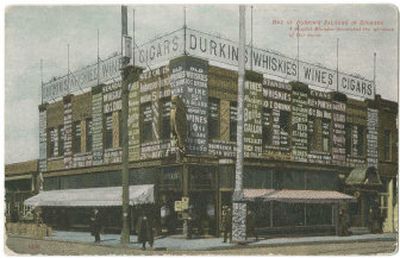
Which leads us to the story behind his epitaph. In the early 1900s, a fulminating temperance preacher declared in a sermon that he wished he could dress (decorate) Jimmie Durkin’s saloon windows “in a way to display the tragedy of drink.”
Durkin immediately took up the reverend on the offer and offered to pay for it. So the reverend decorated the windows with pictures of ragged women abandoned by hard-drinking men and with statistics about the ill-effects of liquor. One window contained a pile of sad, worn-out shoes, next to a gleaming pair of patent-leather shoes with gaiters, which were labeled, “The shoes of the saloon-keeper.”
Durkin allowed the windows to remain up for weeks, prompting the preacher to utter these words, “Jimmie Durkin is a man of his word.”
Yet Durkin knew what he was doing. The windows worked as a “gigantic publicity stunt” according to The S-R, and attracted more customers to the saloon than ever.
Still, Durkin took the minister’s words as a kind of personal motto and even had them embossed on his liquor bottles – which are sought-after collectibles today.
And yes, his tombstone at Greenwood Memorial Terrace also contains that slogan. Jimmie Durkin remained a man of his word to the end.