
Nothing can stop them

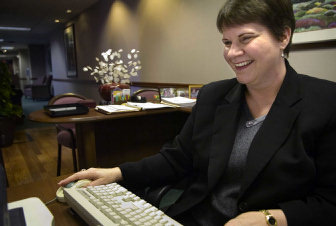
When Sivi Smith was diagnosed with breast cancer a couple of years ago, she never considered taking a break from her job during treatment.
“If I worked, I couldn’t just sit there and dwell on it,” says Smith, a 54-year-old executive assistant to the president of Inland Northwest Bank. “Working just helps you still feel like part of the living.”
Besides, she says, “You can’t fall apart here and sit here and cry all day. It keeps you from losing it.”
Recently, there have been numerous well-known cases of cancer patients continuing work during treatment. Spokane Mayor Jim West, who lost his seat in a recall election last month, kept working during several rounds of chemotherapy. Washington Gov. Christine Gregoire campaigned for office during treatment.
Apple Computer Inc. CEO Steve Jobs took about eight weeks off in 2004 after surgery for pancreatic cancer before going back to work. And a Broadway star, Maria Friedman, performed on opening night, 10 days after a lumpectomy for breast cancer, with her radiologist waiting backstage.
A new study proves just how common it is for patients to stay on the job during chemotherapy, radiation or other therapies.
Just about 60 percent of men and women continue working during cancer treatment, according to a study of 1,433 cancer patients published in the journal Cancer. Even for those who stop working, most return in the first year after treatment. Continuing work depended, in part, on the type of cancer a person had.
Those with cancers of the breast, uterus, prostate and thyroid were most likely to keep working, the study found. People with cancers of the blood, nervous system, head or neck were least likely to be able to stay on the job.
Of course, many people keep working for purely economic reasons: They simply don’t have the financial luxury of forgoing a paycheck or medical benefits. But many others rely on the support and feeling of normalcy that the workplace provides.
After having surgery to remove the tumor and some lymph nodes, Smith underwent radiation five days a week for seven weeks.
She decided against chemotherapy since her cancer was caught at an early stage. But the radiation left her “absolutely exhausted” and with burns and blisters.
She scheduled her appointments for late in the day so she wouldn’t have to miss work and then she’d go home and crash at the end of the day.
But flexibility is the key when it comes to working during treatment.
Linda Pierce, a librarian at Gonzaga University, had planned on continuing her full-time job after being diagnosed with ovarian cancer five years ago. But surgery, chemotherapy and radiation took its toll, so she decided to go to a four-day schedule.
“I probably could’ve worked a 40-hour week but it would have totally exhausted me,” Pierce says. “It’s very difficult to stop doing something, and you have to be able to do that.”
Some days, she says, “I was too tired to watch TV. I was too tired to read.”
“Sometimes people feel like they should be able to work during chemo, because other people do that,” she says. “But you can’t make yourself be better and you can’t make yourself not be tired.”
Spokane oncologist Dr. Joni Nichols, with Cancer Care Northwest, says she generally leaves the decision to continue working up to her patients. More than half of them stick with their jobs during treatment, she says.
“Cancer is becoming a chronic disease,” Nichols says. “There are a lot of patients in our community that continue to work.
“I think the biggest thing is people need to be able to have some flexibility.”
Treatment sometimes causes a drop in white blood cell counts, leaving patients more susceptible to infection. In those cases, people with jobs that force them to interact with the public need to be especially careful, she says.
Schoolteachers, for example, should ask that sick children stay home, Nichols says. And employees should ask that they have their own phone and computer keyboard, to avoid sharing germs.
“I usually leave it up to the patient and just really tell them to trust their judgment,” she says. “And trust their body.”
Teri Eveland found a rock-solid support group among her co-workers at Kaiser Aluminum when she learned she had breast cancer 12 years ago.
Even though she could have stayed home during treatment and still gotten paid, Eveland came to work each day in the sales department. Instead of working from 7 a.m. to 3 p.m., she slept in a bit and came in at 9 a.m.
“I thought if I just stayed at home, I might sit around and worry or mope and get depressed,” says Eveland, who lives in Spokane Valley and now works as an administrative assistant at Gonzaga.
“The people I worked with were so supportive and loving; that was the strength I could draw from.”
Eveland, who lost her mother to breast cancer, says her boss at Kaiser also went through the same experience.
“If I was having a bad day, I could get my friends together during lunch break and all cry together,” she says.