
Tay-Sachs
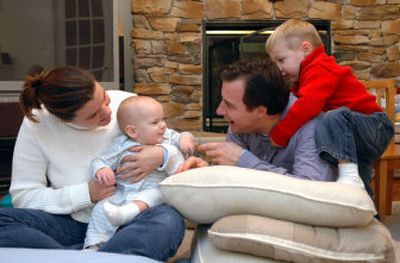
The cherry-red spots on the baby boy’s retina told a tale of genetic catastrophe: Conner Hopf, 11 months old, almost surely will not live to see his fifth birthday.
Before he dies, he’s likely to go blind, lose much of his hearing and become unable to move. He will probably never learn to speak.
He has a rare degenerative disease known as Tay-Sachs, which once principally struck children of Eastern or Central European Jewish heritage. But a nationwide screening program for prospective parents that began in Baltimore 30 years ago has been so effective that the number of Tay-Sachs babies born to parents who identify themselves as Jewish has fallen by 90 percent.
That still leaves about 20 children diagnosed with Tay-Sachs in the U.S. each year. For their parents, including Carl and Desiree Hopf of Ellicott City, Md., the news brings a cruel, irrevocable surprise. Like the Hopfs, at least two-thirds do not fall into Jewish or other ethnic groups with a high risk for the disease.
When she heard Conner’s Tay-Sachs diagnosis in September, Desiree Hopf, a former pediatric intensive-care nurse, knew what the words meant. But because her family wasn’t Jewish, she had trouble believing them.
“What do you mean, Tay-Sachs?” she recalls saying. “It was nothing short of earth-shattering.”
The current face of Tay-Sachs, one of the first genetic diseases to meet criteria for a public prevention program, shows the possibilities and the limits of carrier and prenatal testing for genetic disease.
Even as screening for a host of inherited maladies becomes available, scientists, physicians and patients must wrestle with how much they want to know – and at what cost.
For example, the American College of Obstetricians and Gynecologists now recommends making information about carrier screening for cystic fibrosis available to all couples who seek prenatal care. The recommendation is universal, even though members of some ethnic groups, such as Asian- and African-Americans, have relatively little risk of producing a child with the disease.
But the organization’s recommendation for Tay-Sachs screening extends only to people in a high-risk ethnic group, or with a family history of the disease.
Scientists debate whether to make screening more widely available when the overall risk of producing a Tay-Sachs child in the general population is so low.
“I think we’re coming to that time that there has to be a very serious discussion about this,” said Dr. Susan J. Gross, co-director of the Division of Reproductive Genetics at Montefiore Medical Center and an associate professor at the Albert Einstein College of Medicine in New York.
“Here’s a disorder with a very effective screening test. It’s very cheap, and you do it once in your lifetime. … Some people may feel that allowing a certain number of Tay-Sachs disease cases every year is acceptable. I can’t say that.”
The American College of Medical Genetics in Bethesda, Md., is re-examining its standards on carrier screening for diseases based on ethnicity, said executive director Michael Watson.
“The way we developed cystic fibrosis screening is as a pan-ethnic panel,” he said. “That’s certainly the direction in which we’re trying to think about all areas of screening.”
But Dr. Michael Kaback, who pioneered the mass screening of Jews for Tay-Sachs, said more widespread testing is not a practical way to prevent the few cases that remain.
“It is not medical practice in America today to offer every screening test to every couple for every disease,” said Kaback, now a professor of pediatrics and reproductive medicine at the University of California, San Diego School of Medicine and director of California’s Tay-Sachs prevention program. For couples outside the high-risk ethnic groups, he said, “It’s a risk that’s extremely low. If one were to take action on such low risks, one would never leave their house.”
Tay-Sachs is caused by the absence of Hex-A, a vital enzyme. Without it, fatty substances accumulate in the nerve cells of the brain, eventually destroying them. In its most common infantile form, the disease begins its damage in the womb, although children might appear to develop normally for months before they start to lose basic skills. No effective treatment exists.
About one in 250 people in the general population carries the Tay-Sachs gene, but among Jews in the United States, it’s one of every 27, according to the National Human Genome Research Institute. Non-Jewish French-Canadians living near the St. Lawrence River and in the Cajun communities of Louisiana have a similar incidence of Tay-Sachs. Americans of Irish descent have a slightly lower but still elevated risk – one study estimated it between one in 52 and one in 192.
For a child to have Tay-Sachs, both parents must carry the gene. Each of their children has a 1-in-4 chance of having the disease, and a 50 percent chance of carrying one copy of the gene but living a normal, healthy life.
Couples who know they carry the gene before they have children can decide whether to adopt, stay childless or have an embryo or fetus tested for the disease – and possibly terminate the pregnancy.
After a simple blood test was developed to check carriers, Kaback, then an assistant professor of pediatrics at the Johns Hopkins School of Medicine, headed a program to administer the test to large groups at local synagogues and community centers.
At the time, two to four babies with Tay-Sachs were being born in Maryland each year, almost always to parents of Jewish heritage. Within three years, the screening program had tested 10,000 people and found 400 carriers, including 24 who had married each other.
Awareness of the carrier test spread across the country. In many Jewish communities, people are screened well before marriage. By 2000, more than 1.4 million people had been tested.
Fewer than a third of the children with Tay-Sachs today are born to parents who identify themselves as Jewish, said Jayne C. Gershkowitz, executive director of the National Tay-Sachs & Allied Diseases Association.
Often, that’s because the parents might not know all their family histories. Because the Tay-Sachs gene is recessive, it can pass through generations before manifesting itself in disease.
“The entire population has an element of risk,” Gershkowitz said. “Most people don’t understand that. You’re basically looking at a disease that’s pan-ethnic, but because it’s such a rare disease, people don’t know that.”
Gross, the Montefiore Medical Center geneticist, pointed to the example of former Secretary of State Madeleine Albright, who learned in adulthood that her parents had been Jews. “As time goes by now, in our country those kinds of barriers are falling by the wayside,” she said.