
Almanac knows weather
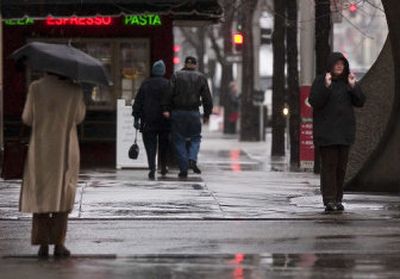
Undoubtedly we will get another workout with the snow shovels before it’s all over, but wouldn’t it be nice to know when we could expect that to happen?
Look no further than “The Old Farmer’s Almanac.” Since 1792, this publication has been an authority on long-range weather forecasts.
“People come to us for our weather forecasts because historically we are 80 percent accurate,” says Janice Stillman, the almanac’s 13th editor.
Using a regionalized long-range prediction of temperatures and precipitation, “The Old Farmer’s Almanac” breaks its predictions into blocks of dates within a month and forecasts whether the temperatures and precipitation will be above or below normal ranges during each period.
“We aren’t going to tell you how much rain you are going to get or how much snow is going to fall or what the temperature will be, but we will tell you how it will be relative to normal,” says Stillman. “That is, will it be above normal temps or below normal?”
Stillman says an almanac is defined as a calendar of the heavens that predicts and announces Mother Nature in all its rhythm and glory.
“Being a calendar, it predicts and announces events in the year: sunrise and sunset, moonrise and moonset; length of day, astronomical events, such as conjunction of planets and other celestial bodies, meteor showers and bright stars.”
In the very early days, almanacs were critical sources of knowledge on all kinds of astronomical data and weather forecasts.
“We had an agrarian society back then,” says Stillman. “Everyone grew their food and tended their own animals.” Back then, people needed to know “the best days to slaughter their animals or put up a fence or set out plants underground or put plants in above ground. They really looked to a calendar book, a farmer’s almanac, to help them with that kind of information.”
“The Old Farmer’s Almanac” took this a step further though. Besides the forecasts and celestial calendars, its creator, Robert B. Thomas, wanted a more-entertaining almanac than other its competitors.
He included handy advice, like how to build a fence, keep financial accounts for the farm, calculate interest payments, and home remedies and cures for whatever ailed man or beast.
From the beginning, Thomas believed that sunspot activity on the sun affected earth’s weather.
“He did not then have access to the kinds of information, like satellite data and ocean temperatures, whatever our meteorologists use to put this stuff together,” says Stillman. “He did believe in the sun’s influence on weather patterns and in particular (that of) the sunspots.”
Meteorologists, climatologists and astronomers at “The Old Farmer’s Almanac” still follow this method. Stillman says that the new satellite and climate reading technology has only improved their accuracy.
So how is a book developed for the agrarian societies of 200 years ago still relevant in our modern society?
Stillman says people still want the information.
“It’s a handy reference tool. You can carry it away or look it up on our web site; www.almanac.com. If you use a paper copy, you don’t have to plug it in or download it,” says Stillman.
So what is the 2006 Old Farmer’s almanac forecast for our region? Overall, winter is supposed to be mild and dry, while the summer is apt to be hot and dry. When I compared our recent cold snap with Stillman, we found that it fit with December’s forecast of below-average temperatures and little precipitation early in the month, followed by chilly weather with rain and snow showers later in the month.
As to the rest of the winter, we should look for snow at the end of January, and again in late February and March.