
Classes at Cd’A School of Woodworking is for wanna-be builders from young people to retirees
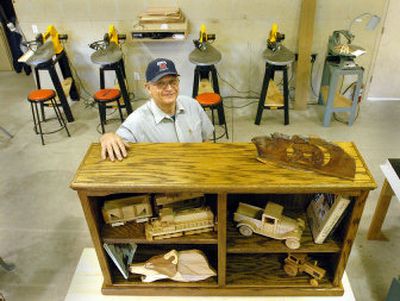
Might you like to add a handmade garden bench to your yard this spring? Or an Adirondack chair? If you made them yourself you’d save some money and you might be able to use some recycled wood to cut expenses even more. The thing is, you don’t have power tools, a woodshop, or the know-how.
No problem. Skip Gillespie does.
Gillespie is owner of the Coeur d’Alene School of Woodworking, a business he started a year ago.
“I try to focus classes on projects that are useful and provide the opportunity to master woodworking techniques,” he says.
Besides teaching students to make a bench or chair, Gillespie and his instructors teach classes in which students can learn to make magazine racks, bookcases with glass doors, rocking chairs or shop workbenches.
Learning to use new tools is part of the deal. For instance, when making panel doors for cabinets, students learn to use a router, router table and table saw.
Each class size is limited to five or six students so instructors have plenty of time to spend with each person. Small class size also means there’s no waiting to use tools. Classes run from three to 15 hours long with tuitions ranging from $45 to $190.
The school staff can also show students how to use reclaimed wood in class projects. A common pallet, re-sawn and run through a thickness planer, might reveal beautiful tulip wood. Glued together, such pieces could be appropriate for decorative work.
From trashed freight pallets of oak, mahogany and ash, the school’s instructors have salvaged wood to make jewelry boxes, or to turn on a lathe to make pens.
“I probably gave away about 20 pens this year as Christmas gifts,” Gillespie says.
Cedar scraps found on a fencing company’s scrap pile were used to build Adirondack chairs in a recent class. Even sawdust is recycled into wood filler.
Besides running his woodworking school, Gillespie is an architectural drafting instructor at North Idaho College. He began his woodworking instructional career as an industrial arts teacher for 10 years in both middle and high schools, and then went on to work for 15 years in the construction industry.
“But my passion for 25 years had been to do something for seniors in their retirement years,” he says. That “calling” was answered with the woodworking school. But interest in the school from community members has widened the original curriculum to include classes for everyone from kids to “young retirees.”
Student Sandy Bauer, retired from Boeing in Seattle where she was a configuration management specialist, came to the school to make a bookcase with adjustable shelves for her home.
“I absolutely love doing woodworking,” she says. “I love the smell of newly cut wood. And the accomplishment of building things myself, just feels so good – and of course the quality’s going to be better than average because I’m using good materials and building it accurately.”
Another woodworking school enrollee, Mary Nickol, began making her own tapered-leg hall table in November.
Nickol’s table is a lesson in mortise and tenon joinery, Gillespie says.
Also, since she was using discarded maple from a cabinet shop, each leg was made from two pieces, which required she learn to “read” the wood to match the grain. Nickol also learned to use a router for the project.
“I like knowing I’m making something that won’t be in the landfill soon,” Nickol says. “So much is made to not have a long shelf-life – even some high-end furniture isn’t made too well. I’m making something to last.”