
Iran pulls assets from European banks
TEHRAN, Iran – A defiant Iran announced on Friday it has begun pulling its foreign currency accounts out of European banks to protect its assets from possible U.N. sanctions over its nuclear program.
As analysts estimated the amount of those funds at up to $50 billion, Iran also called for a reduction in OPEC oil production – raising the possibility the country would use oil in its standoff with the West. Iran pumps about 4 million barrels of oil a day, making it the second-largest producer in the Organization of Petroleum Exporting Countries, after Saudi Arabia.
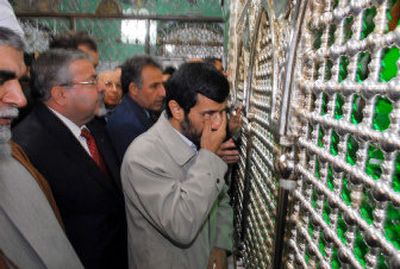
Underlining his challenging stance, Iran’s hard-line president, Mahmoud Ahmadinejad, held a meeting in Damascus, Syria, on Friday with leaders from the Palestinian militant groups Hamas and Islamic Jihad.
The two governments expressed support for Iran’s right to the peaceful exploitation of nuclear power and criticized what they called the “selective and double-standard policy practiced by some international powers in this regard.” The remark was a reference to U.S. and European opposition to Iran’s enrichment of uranium, a process that can produce material for atomic bombs.
The meeting came a day after an Islamic Jihad suicide bomber blew himself up in a Tel Aviv restaurant, wounding 20 people. Israel accused Iran and Syria of being behind the attack, a charge both countries denied.
The currency withdrawal signaled that Iran was willing to weather U.N. punishment rather than abandon its nuclear ambitions, which the United States and some in Europe say are to develop atomic weapons. Tehran insists its program is for peaceful purposes only.
Friday’s move also deprives Europe of an important lever to influence Iran and could weaken its resolve to push Iran to give up key parts of its nuclear program, analysts said.
Crude oil prices rose above $67 Friday amid concern over the Iranian nuclear dispute, unrest in Nigeria and al-Qaida’s threat of terrorist attacks in the United States.
Analysts fear oil prices could surge much higher – even beyond $100 a barrel – if the U.N. Security Council imposes trade sanctions on Iran over its nuclear activities.
Iran’s Oil Ministry confirmed on Friday that the country is pushing for OPEC to cut its overall production.
The announcement of the withdrawal of Iran’s foreign currency accounts from Europe came from the country’s Central Bank governor, Ebrahim Sheibani.
“We transfer the foreign exchange reserves to wherever we deem fit,” Sheibani was quoted as saying by the semiofficial Iranian Students News Agency. He would not say how much money was involved or where Iran would move it.
It was not immediately clear whether Iran’s investments and property in Europe would also be affected.
Iran’s assets in the United States were frozen shortly after the 1979 revolution that toppled the pro-Western Shah Mohammad Reza Pahlavi and installed a clerical regime.
Swiss officials were tight-lipped over whether Iran’s move might include Switzerland, which is not part of the European Union, or if it meant more Iranian money might be on the way.