
Family ties

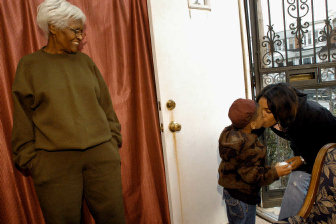
By 7:30 a.m., Pearl Stanton, a great-grandmother, is dressed and downstairs looking out her window, waiting for Pooh.
“I hope he got a good night’s rest,” she says, “because he’s a crazy little boy. They say I spoil him.”
Pooh is Pearl’s great-grandson. He is dropped off by his mother — Pearl’s granddaughter — who then rushes to work.
“On two wheels,” Pearl quips.
Pearl, 76, will watch the 2-year-old all day — “I’m trying to train him to the pot,” she said.
He is not the only one she cares for.
On the second floor of this Southwest Philadelphia rowhouse, in bed for two years with dementia, is Pearl’s mother, Vidia Smith, 94.
Vidia is Pooh’s great-great-grandmother.
Pearl will boil chicken and greens, chop them, and spoon-feed her mother.
Often, Pooh will help feed his great-great-grandmother, climbing on a chair by the bed, and smothering her with kisses. He will try to steal her juice.
“No. No. No. This ain’t your juice,” Pearl corrected Pooh one morning. “This Granny’s juice. Go downstairs and get yours. This Granny’s juice.”
So what is going on here?
Maybe the future: Five generations of one family all helping one another out.
As Americans live longer, multigenerational ties have become increasingly important.Vern Bengston, a gerontologist and sociologist at the University of Southern California, is among those who contend that a shift is taking place.
“For many Americans,” he argues, “multigenerational bonds are becoming more important than nuclear family ties for well-being and support over the course of their lives.”
He adds: “Because the increase in marital
instability and divorce over the last several decades has weakened the ability of nuclear families to provide the socialization, nurturance and support needed by family members, I argue that kin across several generations will increasingly be called upon to provide these essential family functions in the 21st century.”
Help among generations will come in many forms, over many years. Roles will change over time. Pearl cares for Pooh today, for instance. But in a decade, he could be feeding her.
Bengston also contends, based on his research, that support more often flows down, from older generation to younger, rather than up.
In more affluent families, older generations increasingly provide financial support to younger ones – paying for colleges, camps, even mortgages.
In fact, Bengston said, “Supporting their children and grandchildren, that’s become the new preoccupation of the new young-old – trying to help their grandkids get started.”
The weakening of the traditional nuclear family is well-known. According to the National Marriage Project at Rutgers University: One-third of all children in America are now born out of wedlock. More than four in 10 marriages will end in divorce. The number of couples living together outside marriage – now more than five million – has increased 1200 percent between 1960 and 2004.
At the same time, the number of multigenerational families is increasing: In 1900, nearly 20 percent of U.S. children were orphaned by age 18. In 2000, 68 percent of children, by their 18th birthday, had four grandparents living, according to Peter Uhlenberg, a researcher with the University of North Carolina.
A 20-year-old today has a 91 percent chance of having a living grandmother. A 20-year-old in 1900 had only an 83 percent chance of having a living mother.
By 2050, according to census projections, as many Americans will be younger than 18 as older than 65.
Think of the members of this five-generation family as instruments in a symphony, each doing its part.
The great-great-grandmother, Vidia, lies in bed. She was once the family matriarch, vital and larger than life. She worked 45 years at Presbyterian Hospital in the laundry department. She watched her grandchildren and great-grandchildren, much as her daughter, Pearl, watches Pooh today.
Vidia is now the recipient of care from everyone else. Giving her love and dignity gives them meaning.
Pearl is her only child, the great-grandmother now.
Pearl separated from her husband by age 25; with help from her mother, she raised three children.
Like her mother, Pearl worked at Presbyterian Hospital, for 41 years, most as a kitchen supervisor, making sure patients’ meals were prepared and delivered properly.
Now she rises four or five times a night to check on her mother, giving her water or an extra blanket. She grinds up her mother’s pills and mixes the medicine into her food. She washes her mother’s clothes and linens, running each load through the washer twice, hanging clothes on the line most of the year.
Pearl’s youngest child is Pauline Smith, 54. Pauline is the grandmother of Pooh. She lives around the corner. Pauline worked 33 years at Presbyterian Hospital, and six years ago moved to the Hospital of the University of Pennsylvania, part of the same health-care system. She is a receptionist.
Pauline goes to her mother’s house every day after work. She will change the diapers of her grandmother and grandson, feed them dinner, and give her mother, Pearl, a break.
Pauline will watch Pooh, either at Pearl’s house or at her own, until her own daughter, Corin Rushing, 27, Pooh’s mother, picks him up at night.
Corin worked at Presbyterian Hospital as a teenager while she attended Girls High. At the University of Pittsburgh at Johnstown, she met her husband, a basketball player, Khristopher Rushing, who was two years older. After Rushing proposed, Corin dropped out of school, a mistake she now realizes, and didn’t earn a degree.
They married in June 2002 and moved to Detroit, her husband’s hometown. He got a job with the NBA’s Detroit Pistons, organizing summer camps for youths. Corin was five months pregnant with Pooh when her husband died of a heart attack on a basketball court. No one knew he had a heart condition.
“He never saw his son,” said Corin, weeping. “He did feel him kick.”
Corin moved back to Philadelphia, where Pooh was born. She named him Jakari Khristopher Rushing. Pearl, the great-grandmother, couldn’t remember Jakari, so she called him Pooh.
For the record, Pooh identifies the generations of women in his life as follows: mother is Mom; grandmother is Grandmom; great-grandmother is Mom-Mom. And great-great-grandmother is Granny.
America has long had the Sandwich Generation – baby boomers taking care of children and aging parents.
Pearl, taking care of her mother and Pooh, is a variation. Carol Levine, director of the Families and Health Care Project at the United Hospital Fund in New York, described this arrangement as a “club sandwich.”
Informal caregivers like Pearl are the backbone of the American caregiving system. An estimated 30 million Americans care for family and friends, for free, out of love and duty.
The care they provide is worth an estimated $257 billion, said Peter Arno, director of the Division of Public Health and Policy Research in the Department of Epidemiology and Population Health, at Montefiore Medical Center in New York.
Pearl does get critical help for her mother from outside the family. For a year, she has relied on the assistance of a home health aide for three hours a day. A few weeks ago, the aide’s time was increased to five hours a day.
Pearl suffers herself from a bad heart, a pinched nerve in her neck, and wicked arthritis in her back. She can no longer lift her mother and change her diaper.
Romona Washington — an employee of a private nursing company, but paid with taxpayer money under Medicaid – comes in the morning to wash and change Vidia.
Washington also returns at 11:30 p.m. to change Vidia’s diaper so that Vidia can sleep comfortably.
Washington, who is in her 50s, is a minister and lawyer who once directed the Philadelphia Women Against Abuse Legal Center.
When her husband was dying, she was on the receiving end of home care and vowed one day to give back. She sees helping this family as her ministry.
“I look at it as a team effort,” she said. “Everybody pitches in and that’s what helps keep it going. That’s what helps keep Miss Pearl going, that’s what helps Miss Vidia. The more you support the primary caregiver, the better it is for everybody else around.”
Many more family members contribute to the harmony of this five-generation family.
Pearl’s son, Ernest Stanton, paid for a new roof and kitchen renovation, but finds it painful to visit Vidia.
“My son, he was her heart and soul coming up,” Pearl said. “He can’t take seeing her like that. But anything he can do for his Granny, he’ll do it.”
Pearl has a daughter, Irine Roane, living in New Mexico, who calls nightly at exactly 9:10. Irine’s daughter, Erin Roane, 28, lives with Pearl now. Erin works long hours at a group home, and isn’t around much during the day, but helps when she can.
Pauline’s husband, Norbert, works 3 to 11 p.m. But he is up every morning to bring Pearl, his mother-in-law, coffee.
This is ritual. Pooh will meet him at the door, take the sugars and creams, and pour them into Pearl’s coffee.
Pooh can’t do much on the caregiving end, but he provides joy and purpose for everyone else. He’s a beautiful boy, big for his age, and at times very much in the “terrible twos.” Pearl wears a black plastic belt around her neck, and will sometimes slap Pooh’s backside with it, never hurting him, but letting him know who is boss. He will on occasion find himself punished in the “hot seat,” a little folding chair just his size.
Pearl knows that when Pooh goes off to school she will be lonely.
Less tired, but lonely.