
Technology goes boldly
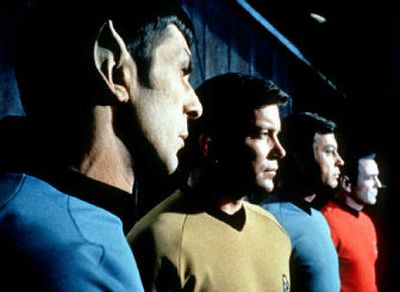
Denny Crane, William Shatner’s latest alter ego on “Boston Legal,” has a new girlfriend. But that’s not important right now. What’s important is that, on a recent episode, she sent him risqué images on his new flip phone. What’s important is that he flipped it open in one fluid, familiar, Kirk-like motion.
And what’s important is that, thanks to an in-joke from the producers, it chirped — just like its great-great-great granddaddy, the communicator, did on the original “Star Trek” series 40 years ago.
It was a half-second piece of audio — just a microscopic wink-nudge for the knowing and the geeky. But how could you illustrate more dramatically something that is obvious when you think about it: When it comes to gadgetry, so much of “Star Trek” has already come true.
Today, we take sliding double doors with motion sensors for granted, not on our starship bridges but in our supermarkets and Home Depots. We’ve used, abused, scorned and abandoned by the hundreds the floppy disk, whose earliest public incarnation was in the thick, Day-Glo squares that Spock and Dr. McCoy used to access information from the Enterprise’s mainframe computer.
Personal computers in your own room — on your desktop, delivering information and video and always connected to a larger network of information — came into their own on the original Enterprise. And what is a smartphone, be it Treo, BlackBerry or Sidekick, if not a tricorder, a multipurpose electronic tool aimed at gathering miscellaneous information about the world around you?
There’s more, of course. Shirts that repel dirt and Levi’s jeans that contain an iPod docking station. Handheld medical scanners that help gather patient information. Diagnostic beds that monitor vital signs.
And the communicator. Oh, the communicator.
I was the kid who worshipped that little piece of calibrated machinery, ever since my older sister plopped the infant version of me down in front of a television to watch my first episode. I built the AMC plastic models of it and shouted “Beam me up, Scotty,” into them. Any little handheld box with a flip top that was discarded by my parents became, in the woods behind our house, a tool for me to contact the bridge of the Enterprise.
Today, I own a Motorola RAZR, a sleek, black piece of consumer electronics that I bought in a weak moment because it looked more like a communicator than any previous-generation Motorola flip phone. Of course, that’s been my rationale since 1992 when I bought my first Motorola flip phone — about 20 flip phones ago.
The pace of life, and of science fiction, has increased markedly since the first “Star Trek” aired from 1966 to 1969. Subsequent incarnations of the show have featured far more advanced technology — including the holodeck, which, when you think about it, isn’t so farfetched in our daily quest for better, more realistic fake entertainment environments. Nanotechnology, cloning, organic computers — all are becoming a part of real science faster than we ever dreamed. Fine, there’s no transporter yet, but give it a few decades.
I like my RAZR. I like the way it sits in my hand, flat and sleek, and flips open in a way that even the most mundane of phone calls could be, just might be, the open hailing frequency that could change the world.
And I’m sure when the next-generation Motorola flip phone is released in coming months, and it looks even more like the gadget that James T. Kirk used to order the day saved, I’ll be in line with my credit card to get just one more half-step closer to this fascinating universe I’m still trying to reach.
I probably won’t need it. But resistance, as they say, is futile.