
Ode to the wood stove

In northern climes in wintertime, many people relish the warmth and ambiance of a good wood fire. Maybe it’s ancestral – the cave, the clan, the fire pit – but comfort is one thing, economics is another. Anticipating a cold winter this season, and judging that post-Katrina oil and natural gas prices would take a big jump, homeowners began looking for lower-cost heating alternatives. Local hearth industry professionals say many consumers around here turned to wood and pellet stoves.
Tom Anstrom, Barton’s Fireplace Shoppe, says that in November-December 2005, “Wood and pellet fireplace inserts all but disappeared and suppliers couldn’t restock.”
While the supply is back to normal now, the up kick in demand has continued.
“Wood is the only form of heat where you have control over the fuel source,” says Duane Spurbeck, general manager of Falco’s Stove & Fireplace. “As a homeowner, you can be more self-reliant.”
But whether you’re considering wood heat as a primary source, or simply planning to use it to augment an existing heating system, there are efficiency and cost issues to consider. Here’s a rundown of the most common stoves:
Fireplaces – The least efficient of many wood heating options, fireplaces expel 47 grams of particulate matter per hour (g/h) from the chimney, because they tend to burn inefficiently. Also, as a traditional fireplace burns wood, it draws in up to 300 cubic feet per minute of room air.
“An open hearth fireplace is using air you’ve already paid to heat, for oxygen and drafting – very inefficient,” says Phil Peard, Spokane Fireplace & Patio.
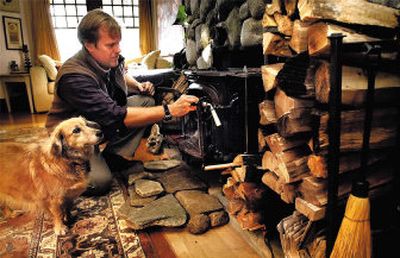
Wood Stoves – The U.S. Environmental Protection Agency (EPA) recommends wood stoves for wood burning because they produce more usable heat, almost no smoke, minimal ash and require about 30 percent less firewood than fireplaces. They also help improve air quality: EPA-certified stoves release only 2-5 g/h of particulates.
EPA-certified wood stoves are of two types: catalytic or non-catalytic. Catalytic wood stoves use a combuster near the top of the firebox. As smoke travels upward, it passes through the combuster’s platinum- or palladium-coated ceramic honeycomb, where leftover flammable gases and particles are ignited. This promotes long, even heat output and heating efficiencies of 70-80 percent.
Non-catalytic wood stoves have a large baffle inside. Its steel pipes super-heat and introduce air through small holes above the fuel in the firebox. As smoke rises, the pre-heated oxygen combusts unused gases and particles, creating a cleaner, more efficient burn.
Wood stoves range in cost from $700-3,000.
Pellet Stoves – As the name implies, these stoves burn ground, dried wood that’s been compressed into small pellets. About 35-40 pounds of pellets are held in a hopper at the top or bottom of the stove, from where it’s automatically moved into the firebox.
Pellet stoves are electronically controlled to optimize the fuel-to-air ratio in the firebox and ensure almost complete combustion and very low emissions. That’s why they are exempt from EPA smoke-emission requirements.
Pellet stove prices range from $1,700-$3,100.
Fireplace Inserts – are similar in performance to free-standing stoves. Both wood- and pellet-burning EPA-certified inserts are available. Wood-burning inserts cost $1,100-$2,800; pellet inserts run a little more at $1,800-$2,900.
Masonry Stoves – Also known as “Russian” fireplaces, these large heating units are usually installed as part of new construction. Research conducted by the U.S. Department of Energy shows that they produce more heat and less pollution than any other wood or pellet burners.
In masonry stoves, heated gas from the firebox passes through long smoke “tunnels” enclosed in the brick or stone masonry mass. The masonry absorbs the heat, slowly releasing it over the next 12-20 hours. Masonry stoves commonly attain a combustion efficiency of 90 percent. However, one disadvantage is they do not provide heat quickly if started cold. And they are rather expensive: construction costs run from about $5,000-$20,000.