
Young scientists show research
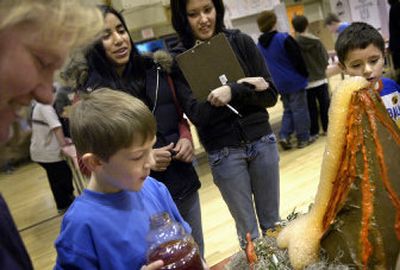
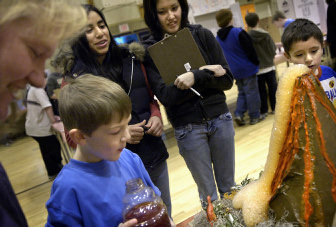
There was a universe of information at the Roosevelt Elementary science fair Thursday night, everything from boiling water to DNA sequencing.
But the most interesting thing in the solar system is the rings of ice and rock orbiting the planet Saturn, according to 12-year-old Tanner Salle. Uranus’ bright blue methane atmosphere surely is a close second, though.
Tanner and other budding scientists struggled to present their findings over the roar of highly popular homemade Hovercraft scooting passengers around the school’s crowded multipurpose room. The hovercraft and other projects – such as a model of the Titanic that actually splits in two and sinks – were entered in a “family” category that allowed parents and siblings to participate.
Next to Salle’s model of the solar system, fellow sixth-grader Jesse Stavines posed the “DNA Dilemma.” Anyone expecting a politically perilous discussion of cloning could breathe a sigh of relief that the real challenge is “How to Get the DNA Out of a Banana.”
Turns out it’s a bit like making a fruit smoothie. You’ll need a kitchen blender, a clean pair of chopsticks and a little bit of isopropyl alcohol. Oh, and a makeshift centrifuge, of course. Put the pulverized banana into a plastic bag, close the bag with a rubber band, and sling it over your head for five minutes.
Sixth-grader Casey Krafft had one of the most talked-about posters of the fair, titled “Yuck! It’s Mold.” He set out to learn which foods grow mold the fastest but had to concede inconclusive results. However, he discovered that his orange grew a completely different kind of mold from what his white bread sprouted.
Sarah Nanny, 11, tackled another domestic mystery. Poised over a pan of boiling water with a cooking thermometer, she demonstrated that plain water boils at 140 degrees.
“Now, let’s add a tablespoonful of salt,” she said. “The water goes up to about 150 degrees, so it went up about 30 degrees. I did the experiment about three times, and the highest the water went up to was about 218 degrees.”
The reason some recipes call for salt, she explained, is that it makes the food cook faster, “and it gives the food more flavor.”
In the sixth-grade team category, Amber Chavez and Karissa Feyen tackled the human anatomy. Again, nothing to worry about – unless a finely detailed, color drawing of a flayed head makes you squeamish. Remove the skin as these two did, and you’ll learn that muscle abounds in the human head.
It takes 10 muscles just to smile, and Amber flashed one that must have used at least that many.
Some of the younger students explored the phases of the moon, what sinks and what floats, and volcanoes. There was a whole Pacific Rim of volcanoes.
“We had about seven volcanoes erupting, which is why it kind of smells like science in here,” said science fair coordinator Tiffiny Santos, a sixth-grade teacher.
Santos estimated that 200 kindergarten through sixth-grade students presented 170 projects in the school’s gymnasium and adjacent multipurpose room. Last year’s first science fair needed only the gymnasium.
Santos couldn’t begin to estimate the “huge” number of parents and other adults who attended the fair.
“It was a great turnout,” she said. “I love the fact that they turned out for science. It wasn’t a spaghetti feed or anything like that.”
No one took the science more seriously than sixth-grader Olivia Noble, who explored the question of whether we can survive in view of the world’s dwindling reserves of oil. We can, she concluded, “because we really have to.”
Fortunately, we have the technology to survive in style, Olivia added.
She handed out fliers suggesting seven ways people can “make a difference” in the battle to conserve energy – and mentioning that she plans to be president of the United States.