
Council weighs TV presence
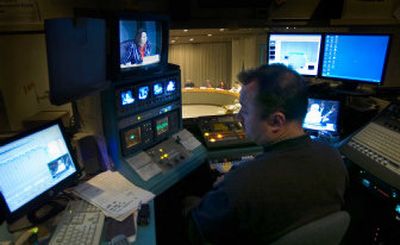
Depending on the outcome of negotiations with Comcast, Spokane Valley residents could be keeping their eye on future City Council meetings from the comfort of their own homes.
In a cable franchise renewal that only comes around every 15 years, the city has the option to push for equipment and access to one or more public channels to broadcast government and educational programs.
“I’d like to have something like Channel 5 has, with a lot of the board meetings, City Council meetings, development meetings …,” said Valley resident John Horstketter, who formerly served on the Spokane Regional Cable Advisory Board.
Public cable channels have enjoyed a long history in the city of Spokane and elsewhere in the state, although Spokane Valley City Council discussions on the idea haven’t developed much enthusiasm so far.
While some think a government channel for Spokane Valley is a good idea, there’s been no public outcry for televised meetings or public cable access at City Council meetings. And a public hearing on the cable franchise in September drew no speakers.
The hearing was part of a lengthy, federally regulated process that cities enter into with cable companies about once every 15 years. Because cable lines are installed in publicly owned dirt, cities are entitled to regulate a few specific parts of how the company operates. One requirement a city can put in place is that the cable company provide equipment and channels for local programming like council meetings.
Spokane Valley also collects about $620,000 per year in franchise fees from Comcast.
“I think it’s a good idea, however, it isn’t a universally accepted concept on the council,” Councilman Rich Munson said.
Even though costs like cameras and production equipment would be covered by Comcast, the budget-conscious council is reluctant to take on the operating expenses of running a station.
“If it were a cost that we have to incur, there are more important things that I want to provide to the city,” Mayor Diana Wilhite said.
The council has discussed Webcasting the meetings as a possible alternative.
City and Comcast employees will meet in the near future to discuss the technologies available to the city, said Deputy City Manager Nina Regor. The council will see another presentation on the cable contract at the end of March, and there will be another hearing on it somewhere down the road.
“We do want additional public input before we come to a conclusion,” Regor said.
Spokane employs three people and spends about $180,000 yearly to operate CityCable 5, a government access station that has been on the air since 1977.
“I think it changes the conduct at some of your meetings,” said John Delay, the station’s director. “People conducting meetings know that people are watching at home.”
Spokane’s City Council and Plan Commission proceedings are broadcast on Channel 5, as well as a call-in show with council members and other locally produced programs.
A recent survey showed 64 percent of cable subscribers in Spokane watch Channel 5 programming, with viewing ranging from a couple of times a month to several hours each week.
Sometimes that viewing even prompts unplanned civic participation. Delay said that from time to time he’ll hear of a resident at a council meeting saying “I was watching this on Channel 5, and I couldn’t sit there – I had to come down and talk.”
CityCable 5’s efforts seem to be appreciated on the other side of the camera as well.
“I’m all for it because a lot of people cannot attend our sessions,” said Council President Joe Shogan.
“I’m pleased that it allows us to be very open as to our processes,” he said.
Formerly a member of the council and the cable board, Cherie Rodgers said the city’s public channels were the No. 1 priority in negotiations for Spokane’s cable franchise that took effect at the first of the year.
Statewide, Washington has a reputation for using technology to bring government to the public.
“We were one of the first in the country,” TVW President Cindy Zehnder said of the state’s public affairs channel.
Over the last 11 years, TVW has worked with cable companies that voluntarily bring the channel to 98 percent of cable households in the state.
“We want to create opportunity for people to directly affect government with all of this great new technology we have,” Zehnder said.
Polling specific to TVW viewership hasn’t been conducted, but she said over a million people visited its Web site last year, and a recent study on trust in government indicated that about 20 percent of Washington voters get information from the station.
“Citizens’ expectations of their government and all the institutions that serve them have changed pretty fundamentally. They want just-in-time delivery,” Zehnder said.
Nationally, the number of public, educational and government access channels has been on the rise since changes to cable regulations in 1984, and flourished in the 1990s, said Deb Vinsel of Thurston Community Television.
Because of their location in Seattle and Tacoma, none of the network channels broadcasts local news in Olympia.
“There are voices that are served by community access that are not served by mainstream media,” she said.
A public channel in Olympia began producing local shows in the early 1980s. Since then, the organization has expanded to include three channels and program topics ranging from dancing to Islam.
Starting a channel can be a tenuous move politically, though, because cable companies often tack the cost of a channel onto cable bills, she said. Content on public access channels – as opposed to government or educational access – also can give politicians headaches.
Mike Hunt TV, a long-running, 1 a.m. show that featured sex, drugs and political commentary on Seattle’s public access station, was taken off the air earlier this month after a small number of people complained that it was obscene.
Nationally, other stations have occasionally grappled with the balance between decency and free speech as various groups sought to broadcast racist, racy or otherwise controversial content.
Those in community broadcasting say such instances are rare and assert that the civic benefits governmental and public access channels provide are worth the trouble when the opportunity comes along to obtain them.
“If you don’t negotiate for it now, it’s going to be eight, 10, 15 years before you can negotiate for it again,” Vinsel said.