
Sunnis threaten parliament boycott
BAGHDAD, Iraq – The largest Sunni Arab bloc in the Iraqi parliament on Sunday said it would boycott the fledgling legislature to protest the kidnapping of a colleague, at a time when the prime minister is pushing a reconciliation plan aimed at bringing religious sects together and lessening the daily violence.
The decision by the Sunni Accord Front, which holds 44 seats in the 275-member parliament, threatens to pull the legislature apart. The announcement came a day after legislator Tayseer Mashhadani and seven of her body guards were abducted in broad daylight on a busy street in a predominantly Shiite Muslim neighborhood of Baghdad. One of the leaders of the Accord Front, Adnan Dulaimi, said the Sunni parliament members would not participate in the legislature until Mashhadani was released.
“This is outrageous and should be remedied by the government with the participation of American forces,” said Dulaimi. “That she and her bodyguards would be kidnapped by criminal gangs is something that should shake Iraq.”
Sunni legislators blamed the abduction on Shiite-led militias aligned with the majority political parties in Iraq. Some accused the Iraqi security forces, who were near the kidnapping site, of standing by and allowing Mashhadani’s convoy to be captured.
The decision to boycott parliament came on a day when Iraq’s national security adviser issued a “most wanted” list of 41 insurgents including the wife and daughter of former President Saddam Hussein, along with many members of his Baath Party regime. Mowaffak al-Rubaie said it took Iraqi security forces nine months to compile the list, and he said they had “serious evidence on every single one of the people.”
Al-Rubaie offered rewards of up to $10 million for information leading to the capture of those listed. The largest bounty was for Saddam’s former deputy, Izzat Ibrahim al-Duri.
At numbers 16 and 17 on the list were Saddam’s eldest daughter, Raghad Saddam Hussein, and Saddam’s first wife, Sajada Khairallah Tilfah Hussein, who are accused of funding insurgents.
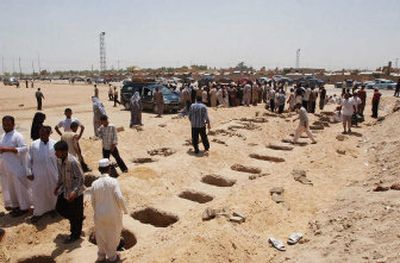
Prime Minister Nouri al-Maliki last month called for Sunni Arab insurgent groups to lay down arms and asked them to return to the political fold, but some have rejected the offer. On Saturday a car bomb killed at least 66 people in a busy market in a Shiite neighborhood in Baghdad, the deadliest attack since the government took power in May.
The violence continued Sunday. A mortar attack hit the Muhammad Bakir al-Hakeem Hospital in the Shula neighborhood of northern Baghdad, killing 8 people and wounding 16 others, said Col. Sami Hassan of the Interior Ministry.
Iraqi patrols discovered 11 unidentified corpses floating in the Euphrates River between Hilla and Ramadi in Western Iraq.
A Shiite lawmaker survived an assassination attempt in the Mahmudiyah area south of Baghdad. The motorcade of parliament member Liqa al-Yaseen was attacked by gunmen, who abducted eight of her bodyguards, but she escaped, said Maj. Gen. Salim Khaiyon of the Interior Ministry.