
Bombing victim’s mother spreads message of peace
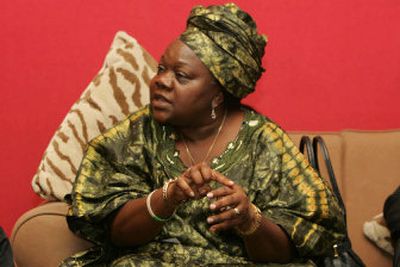
LONDON – Marie Fatayi-Williams stood before the cameras a year ago in the shadow of a bus ripped apart in London’s terrorist bombings, a mother grieving for a missing son with a message condemning terrorism.
Now the Nigerian woman who became known for her impassioned appeal wants to unite others worldwide who agree the time has come to end senseless violence. She’s created a foundation and written a book to spread a message of peace in hopes that others don’t face similar grief.
“What happened to me … could happen to anybody,” she told the Associated Press days before the first anniversary of the attacks. “And how long does it go on, with innocent young people being killed – and nobody says anything?”
Fatayi-Williams is known for a speech given at Tavistock Square, the site of one of four transit attacks that killed 52 people and the four bombers on July 7, 2005. But her story, “For the Love of Anthony,” begins at home in Lagos, with television reports of the first bulletins of the attack.
Frantically, she called his mobile telephone, his office, his home, his friends – frustrated at first, then angry, then despairing. When would he call?
Finally, she decided to continue her search in London, where her son worked in the oil industry. His friends searched the hospitals. Before long, the police were asking for a DNA sample. Emergency help lines set up by the authorities provided little information.
Other families shared her plight in the chaotic days after the attacks, as authorities dealing with packed subway cars hundreds of feet underground and a bus torn apart in a public square tried to count the dead. London’s Metropolitan Police declined to issue a list of the missing but looked into hundreds of missing-person reports.
Desperate for help in finding Anthony, the family decided to talk to the media – hoping that he may merely be missing, injured or even that authorities might have arrested him in a search for potential attackers.
She traveled to London’s Tavistock Square, where 18-year-old suicide attacker Hasib Hussain detonated a backpack full of explosives on the red double-decker No. 30 bus, killing 13, in the most memorable image of the attacks. Only later did she learn her son died there.
At a news conference a year ago, Fatayi-Williams stood beside his photograph.
“This is Anthony. Anthony Fatayi-Williams, 26 years old. He’s missing, and we fear he was in the bus explosion,” she said.
She retraced his steps on the morning of the attack, describing how he normally took the Underground but had called his office to say he was going to get to work some other way because of the disruptions. The other three bombings had taken place about an hour earlier.
She then offered a largely unscripted appeal for peace and of mourning for victims of terrorism – invoking the attacks in New York, Madrid and, finally, London.
“They are not warriors. Which cause has been served? Certainly not the cause of God, not the cause of Allah because God almighty only gives life and is full of mercy,” she said. “Anyone who has been misled, or is being misled to believe that by killing innocent people he or she is serving God, should think again because it’s not true.”
But while the Tavistock Square speech may have been largely off the cuff, her book reflects resolve – the decision that she would not be silent in her grief.
She is throwing energy into the foundation, whose short-term goals include helping to give a voice to victims of terrorism. She is speaking out, trying to pressure the government into conducting a more extensive inquiry into the attacks. A Roman Catholic married to a Muslim, she feels uniquely placed to carry out the mission to fight for human dignity – and the memory of her son.
“If there is one death in terror that is going to change people’s minds, that is going to make people sit back and think again about the boundaries of the world and the reasons for doing the things they do, then let me start that process,” she said. “It might not be much, but I pray this message is my little mustard seed. … We just have to start.”