
Testy Bush defends North Korea policy
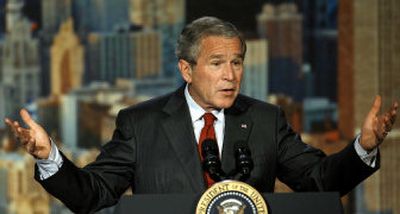
CHICAGO – President Bush on Friday defended his administration’s policies on North Korea, questioning claims that the communist country had grown into a greater threat since he entered the White House, even before North Korea test-fired seven missiles this week.
Bush said he still did not know whether one of the rockets, a long-range intercontinental missile, had been aimed at the United States or if it could have traveled that far. But he said that the controversial U.S. missile defense system had offered a “reasonable” chance of shooting the missile out of the sky had it become necessary.
Still, the president grew testy when he was asked why, if his policies were working, North Korea appeared to be enhancing its nuclear capabilities and growing more aggressive over time.
“These problems didn’t arise overnight, and they don’t get solved overnight. It takes a while,” Bush said, offering the most adamant defense of his policies since North Korea escalated the confrontation this week.
Bush held an unusual news conference outside of Washington as diplomats continued working at the United Nations on ways to pressure North Korea to turn away from its drive for nuclear weapons and rejoin stalled international negotiations. Japan and the United States are pressing the Security Council to vote Monday on sanctions targeting North Korea’s missile program, despite opposition from veto-holding members China and Russia.
At his news conference, Bush took pains to counter a question based on intelligence information that North Korea has expanded its nuclear weapons capability in recent years. Bush declined to dispute the basis of the question, but challenged the reporter: “Can you verify that?”
“We don’t know – maybe you know more than I do – about increasing the number of nuclear weapons,” Bush said, noting that North Korean leader Kim Jung Il has violated proliferation agreements before.
In a series of congressional hearings last year, top U.S. intelligence officials, including then-CIA Director Porter J. Goss, testified that North Korea’s nuclear capability had increased since 2002, when intelligence assessments estimated it possessed one or two nuclear weapons. In his Feb. 16, 2005, congressional appearance, Goss said: “They have a greater capability than that assessment … It has increased since then.”
Director of National Intelligence John D. Negroponte, asked during a Feb. 28, 2005, hearing about the assessment that North Korea had one or two weapons, cited a “potential there for a number of weapons to be in their possession” and said the government in Pyongyang was “regularly” producing fissile material for weapons.
The issue of North Korea’s missiles is contributing to questions about Bush’s foreign policy record and his ability to curb nuclear threats in an election year in which Republicans have decided they will, once again, campaign on national security and the economy. On Friday, the president was on the defensive on North Korea and other national security issues and, during an hourlong news conference, there was little attention paid to his claim that the economy is in good shape.
Bush conceded that the anti-missile system shielding the United States from an attack was “modest” and unproven. But he said it was ready for use to shoot down one of the Korean missiles if needed.
“It’s new research,” he said. “It’s hard for me to give you a probability of success.”