
Gardens evoke tranquility
In a centuries-old tradition, Japanese garden style is an expression of the spirit of the natural world. The careful arrangement of stone, plants and water were traditionally supposed to represent the mountains, forests, lakes, streams and the sea of the Japanese home islands.
The traditional practice of gardening in Japan evolved over many years and was often passed from one generation to the next. Gardening was, and is, an integral cornerstone of Japanese culture.
But what happens when gardeners leave Japan and the source of traditional inspiration? Memory becomes a powerful teacher.
Design from the heart
Tsneko Johnson remembers her father tending his garden in Sendai on Japan’s northeast coast. When she and her husband, Bill, settled in their Indian Trail home 36 years ago, Johnson drew on her memories and began building her garden rock by rock and plant by plant. “I did what I feel like,” said Johnson. “I watched my father do it and sometimes gave water (to the plants).” Her husband says her garden design came from her heart
Today, her garden surrounds their home. Rocks collected around the region and from her husband’s lapidary work anchor plantings of cherry and Japanese maples. Small evergreens shape spaces and frame pathways that take you through the garden. In the center of the front yard, a large laceleaf maple drapes over a bed of rock.
In the back yard, Johnson built a pond filled with water lilies and surrounded by carefully trimmed evergreens. From the bridge, brightly colored koi flash in the sun. On the outer edges of her garden there are Asian fruit trees and a garden full of traditional Asian vegetables.
Gardening from memory
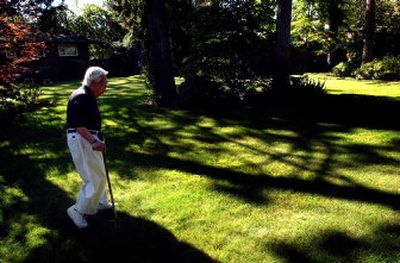
Ed Tsutakawa remembers the carefully tended gardens of the Japanese American community in Seattle before World War II. Even though Tsutakawa played a major role in the creation of the Nishinomiya Japanese Garden at Manito and is a well-known artist, he too designed his garden from memories.
When you step into his backyard garden, the 90-degree late afternoon heat melts away, and is replaced by tranquility – a hallmark of Japanese gardening.
Each section of his garden is revealed only as you move from one area to another. A “brother” stone set in a grouping of plants serves to greet the visitor. Groupings of Japanese maples and conifers hide the rest of the garden from view. More Japanese maples and flowering cherries create a green tapestry that glows in a dozen shades of green in the early evening sun.
“You follow pretty much nature’s way of doing things,” he said. He added that often you won’t see the full impact of nature’s influence until two or threes years later after the plants have had a chance to mature and nature has had its hand with the garden.
Tranquil tapestry
As a little girl, Peggy Heyamoto remembers that at least twice a year a gardener came to trim the black pine that topped the gate to her family’s garden in Tokyo, Japan. When she and her husband, George, moved to their lot a block off Division Street more than 30 years ago, she drew on her memories to create two gardens.
Her front garden began with the placement of three large rocks. Around these foundation rocks, she built dry stream channels of river rock to create the sense of water moving through the garden. She then added Japanese black pine, cypress, cherry, plum and Japanese maples. She anchored them with Japanese forest grass, mosses and small ground covers. The tapestry of the different shades of green highlighted with a few spots of color creates an oasis in view of passing traffic.
Her second garden is a more traditional closed garden off the family room where the Heyamotos can sit in quiet. Here dry stream beds run through plantings of small evergreens and shrubs. An apple and Asian pear shade a sitting area and provide spring color. Bishop’s weed and other small perennials offer a hint of color.