
Work rekindles firefighting tales
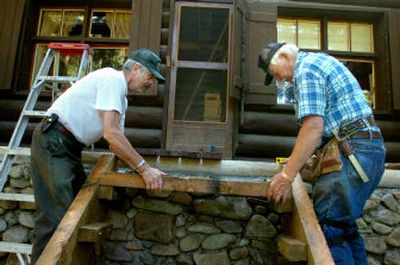
They average about 70 years old each, but that didn’t stop the veteran smokejumpers from climbing around on the roof of a cabin roughly the same age this week.
Nine members of the National Smokejumper Association nailed new shingles onto the Shoshone Park cabin, built by the Civilian Conservation Corps in 1937 near Mullan, Idaho. They remodeled the front porch and deck, too.
The men were smokejumpers – firefighters who parachuted onto the front lines of remote wildfires – in the 1940s, ‘50s and ‘60s, stationed out of Missoula with various crews.
About 150 smokejumpers take on remodeling projects for the U.S. Forest Service each summer – a tradition that began in 1998.
The men say they enjoy the philanthropic work and reconnecting with others who have tales of jumping from planes to battle blazes. They swap stories, sometimes with a bit of embellishment. But many aren’t tall tales at all.
Bob Sallee, 74, worked on rebuilding the front steps of the cabin Tuesday. In 1949, he was one of three smokejumpers to survive the 4,999-acre Mann Gulch fire near Helena that killed 13 of his crewmates. Sallee, the last remaining survivor of the tragedy, was two weeks shy of his 18th birthday when he jumped into a fire for the first time. He lied about his age to get the job.
Andy Boggs, a Forest Service recreation operations manager, said without the work of the smokejumpers, it would likely take the sole maintenance worker in his division all summer to renovate the cabin, which the agency plans to rent out.
For Frank Fowler and Ted Reiger, both 74, the Shoshone Park cabin renovation is a way for two best friends to spend some time together. Fowler and Reiger attended the University of Montana in Missoula together. When Fowler decided to spend a summer smokejumping, he tried to convince his friend to come along for the ride.
“I talked Ted into going,” Fowler said, “then he got selected and I didn’t.”
The Forest Service decided to take the farm boy over the city kid from Washington, D.C., so Fowler stood on the sidelines for Reiger’s first summer of firefighting in 1951.
The next year, the young men fought fires together for the first time. Fowler said the smokejumper mentality is why he joins in on the remodeling projects today.
“We share a work ethic that is universal, to me, in smokejumpers,” he said. “I haven’t experienced that since I was a smokejumper.”
That’s part of the reason Fowler decided to write a novel about his three summers battling blazes. He said he used letters sent home to his mother from 1952 to 1954 to write “High-mountain Two-manner.” Chronicling the experiences made it easier to recount his 28 jumps, which he said were far fewer than some of the others working on the remodeling project.
“I wrote it through the eyes of a 20-year-old,” he said.
He recalled stories of working 14-hour days, seven days a week, with others his age who risked their lives to help curb potentially deadly fires.
“I don’t think any of (the fires) were safe,” Fowler said, “but we felt we were invulnerable.”
Those are the types of stories the smokejumpers share with each other after work hours, said Carl Gidlund, another veteran smokejumper who also is a correspondent for The Spokesman-Review’s weekly Handle Extra section.
“It’s a chance for us to get together and swap lies around the campfire,” Gidlund said, grinning. “We relive old fires and old parachute jumps.”
Hank Jones, 71, fought fires in 1953 and was named squad leader of the nine veterans working at Shoshone Park this week. The retired National Park Service superintendent said there are no perks to the title.
“Just a lot of grief,” Jones said. “But if something goes wrong, they come to me.”